

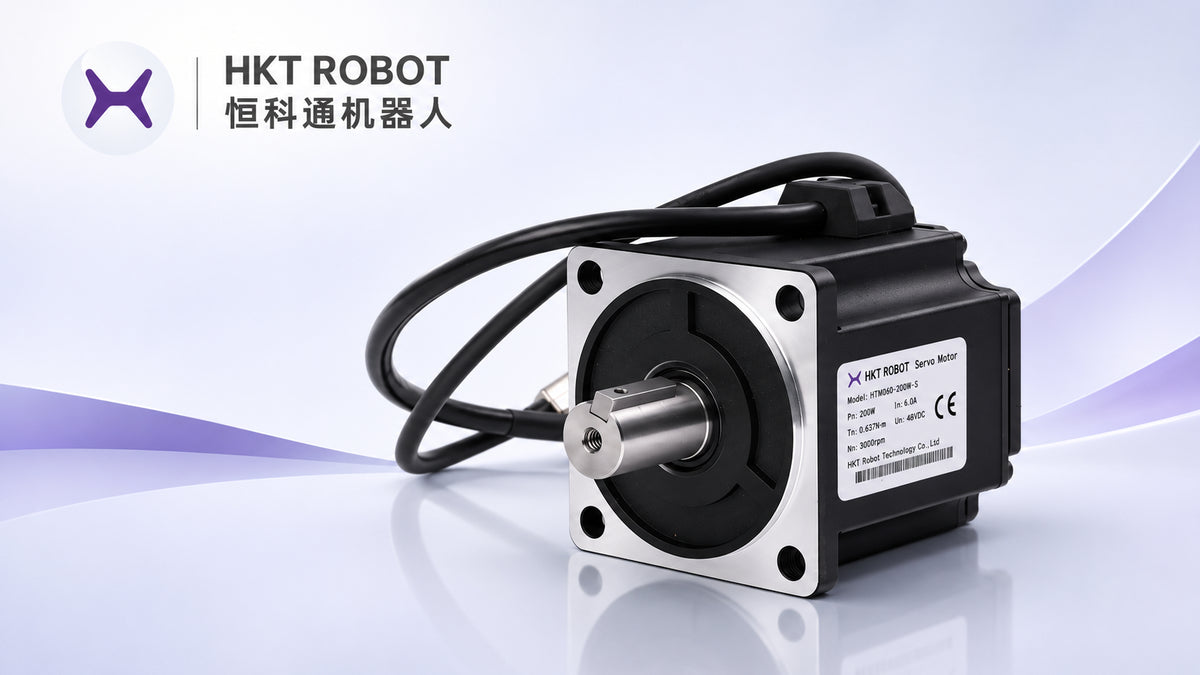
The AGV motor is a key part of the AGV drive system. It affects how much weight the vehicle can carry, how fast it moves, how accurately it controls motion, and how smoothly it runs.
For battery-powered AGVs and AMRs, 24V and 48V low-voltage servo motors are common choices. But what is the difference between them? How do low-voltage servo motors compare with traditional high-voltage servo motors? And how do you choose the right motor for your project?
This guide covers the common types of AGV motors, with a focus on low-voltage servo motors. We will look at 24V vs. 48V systems, low-voltage vs. high-voltage servos, key selection factors, and common mistakes to avoid.

1. What Is an AGV Motor?
An AGV motor is an electric motor used in the motion system of an AGV or AMR robot. It converts electrical energy into mechanical power to drive the vehicle's wheels, steering system, or other moving parts.
In a typical AGV drive system, the motor works with a motor drive, gearbox, drive wheel, and vehicle controller.
The vehicle controller sends motion commands to the motor driver. The driver controls the motor, and the motor transfers power to the drive wheel through a gearbox. This allows the AGV to move.
In a closed-loop system, an encoder provides speed or position feedback. This helps the motor maintain stable speed, start and stop smoothly, and respond accurately to control commands.
So, choosing the right AGV motor is not just about motor performance. It is also about how well the motor works with the rest of the drive system.
2. Common Types of AGV Motors
AGVs and AMRs use different types of motors depending on their load, speed, and motion control needs.
Brushless DC Motors (BLDC Motors)
Brushless DC motors use electronic commutation instead of mechanical brushes. They are compact, efficient, and require relatively little maintenance.
They are commonly used in lightweight AGVs, mobile robots, and compact drive systems.
Servo Motors
Servo motors use a motor driver and feedback device to form a closed-loop control system. They can provide precise speed, position, or torque control.
Servo motors are a common choice for AGVs that need frequent starts and stops, smooth low-speed operation, and accurate motion control.
Stepper Motors
Stepper motors move in steps based on pulse signals. They are often used in low-load, low-speed, or auxiliary positioning systems.
However, for AGV drive systems with continuous movement or changing loads, engineers need to consider possible step loss, heat, and efficiency.
Among these options, low-voltage servo motors are widely used in industrial AGVs and AMRs because they work well with battery-powered systems and offer closed-loop motion control.
3. Why Choose Low-Voltage Servo Motors for AGVs?
Low-voltage servo motors are servo systems powered by low-voltage DC electricity. Common options include 24V and 48V, while some models support a wider DC voltage range.
Compared with traditional high-voltage AC servo systems, low-voltage servos are easier to use with AGV batteries. They are also available in separate motor-and-driver designs or integrated designs, depending on the available space.
Here are some of their main advantages.
Compatible With Battery Power
AGVs and AMRs usually run on lithium batteries or other onboard battery systems. Low-voltage DC servo motors can work with the right battery voltage, reducing the need for extra power conversion.
Precise Closed-Loop Control
With encoder feedback and a servo driver, these motors can control speed, position, and torque. This is useful when an AGV starts, stops, accelerates, or moves slowly.
Compact Design
Some low-voltage servo motors have compact or integrated designs. They can save installation space and reduce external wiring, which is helpful for AGVs with limited space inside the chassis.
Suitable for Frequent Starts and Stops
AGVs often need to start, slow down, stop, and change direction during daily operation. A properly selected low-voltage servo system can provide the response and control needed for these movements.
However, low-voltage servo motors are not better than high-voltage servos in every situation. The right choice still depends on the vehicle's power, load, and electrical system.

4. 24V vs. 48V AGV Servo Motors: How to Choose?
24V and 48V are two common power supply options for low-voltage AGV servo motors.
The main difference is not control accuracy. It is the operating current, power loss, and electrical system requirements at the same input power.
| Feature | 24V Servo Motor | 48V Servo Motor |
| Supply Voltage | DC 24V | DC 48V |
| Typical Applications | Small AGVs, Light-Duty Drives | Medium-Sized And Higher-Power AGVs |
| Current At The Same Input Power | Higher | Lower |
| Cable Voltage Drop | Needs More Attention | Usually Lower Under The Same Conditions |
| Power System | 24V Battery System | 48V Battery System |
| Key Selection Factors | Current, Power, Installation Space | Torque, Power, Driver Compatibility |
4.1 24V AGV Servo Motors
24V servo motors are usually suitable for smaller mobile devices and systems with lower power needs.
For example, small AGVs, lightweight mobile robots, and some steering or auxiliary drive systems may use 24V motors.
One advantage is that they can work with existing 24V batteries and control systems.
However, at the same power level, a 24V system usually needs more current than a 48V system.
For example, if a motor drive system uses 480W of input power, ignoring losses:
-
A 24V system draws about 20A.
-
A 48V system draws about 10A.
This means that higher-power 24V systems need more attention to cable size, voltage drop, and connector ratings, especially when cables are long.
4.2 48V AGV Servo Motors
48V servo motors are widely used in AGVs and AMRs that need medium or higher drive power.
At the same input power, a 48V system usually draws less current. This can help reduce cable losses and voltage drop.
48V servo motors are often a good option for AGVs that run for long periods, accelerate frequently, or need higher driving force.
Common applications include:
-
Drive systems for warehouse transport AGVs.
-
Differential drive systems for medium-sized AMRs.
-
Steering drive wheel systems for industrial AGVs.
-
Mobile robots that need higher continuous power.
However, a 48V motor does not always produce more torque than a 24V motor. If your AGV already uses a 24V battery system and has relatively low power needs, a 24V servo motor may be a good choice. For AGVs that need more drive power or already use a 48V battery system, a 48V servo motor is often more suitable.
The final choice should be based on vehicle load, speed, battery voltage, and driver specifications, not voltage alone.
5. Low-Voltage vs. High-Voltage Servo Motors
Besides choosing between 24V and 48V, there is another question worth asking: Why do most battery-powered mobile robots use low-voltage servo motors instead of traditional high-voltage servo motors?
Low-voltage servo systems usually run on DC power. Traditional high-voltage servo systems commonly use AC 220V or AC 380V power and are widely found in industrial equipment.
Both can provide precise motion control, but they have different power supply and installation requirements.
| Feature | Low-Voltage Servo Motors (24V/48V) | High-Voltage Servo Motors (220V/380V) |
| Power Supply | Low-Voltage DC | Usually AC Power |
| Battery Compatibility | Easier To Integrate With AGV Batteries | May Need Additional Power Conversion |
| Electrical Safety | Lower Voltage And Lower Electric Shock Risk | Requires More High-Voltage Protection |
| Design | Compact Or Integrated Options Available | Depends On Motor And Driver Design |
| Motion Control | Closed-Loop Speed, Position, And Torque Control | Also Supports Precise Closed-Loop Control |
| Communication | CANopen, RS485, EtherCAT, Etc. | EtherCAT, Pulse Control, Etc. |
| Common Applications | AGVs, AMRs, Mobile Robots | CNC Machines, Fixed Automation Equipment, High-Power Machinery |
| Main Advantages | Easier Integration With Low-Voltage Battery Systems | Suitable For Some High-Power And Fixed Equipment |
6. Key Factors When Choosing an AGV Motor
Once you have selected the supply voltage, the next step is to choose a motor that matches your AGV's operating needs.
Here are 5 important factors to consider.
6.1 Rated Torque and Peak Torque
Rated torque is the torque a motor can deliver continuously under specified conditions. Peak torque is the maximum torque it can provide for a limited time.
An AGV may need extra torque when starting, accelerating, climbing a slope, or moving against higher resistance.
That is why motor power alone is not enough. You should also check the torque-speed curve, peak overload capacity, and continuous operating requirements.
For heavy-duty AGVs or vehicles with frequent starts and stops, the gearbox ratio, drive wheel diameter, and transmission efficiency should also be considered.
6.2 Encoder Type
An encoder provides speed or position feedback to the servo system. It is an important part of closed-loop motion control.
Two common types are incremental encoders and absolute encoders.
Incremental encoders are used for many speed and position feedback applications. Absolute encoders provide position values and, in certain system setups, can help restore or keep position information.
For AGV drive motors, encoder resolution, feedback stability, and driver compatibility are important.
For steering wheel systems that need to recover the steering angle after a power loss, engineers should also check whether the encoder supports single-turn or multi-turn measurement and how position data is retained.
Keep in mind that a motor encoder provides motor shaft position feedback. It does not tell the AGV its exact location in a warehouse or on a map.
6.3 Communication Protocols
The AGV motor driver needs to communicate with the vehicle controller.
Common options include:
CANopen: Often used in AGVs and mobile robots with multiple control devices.
RS485 / Modbus RTU: Used for parameter settings, status monitoring, and some motion control applications.
EtherCAT: Suitable for systems that need fast communication and synchronized multi-axis control.
Pulse Control: Common in some single-axis position control applications.
When choosing a communication method, make sure the motor driver supports the protocol used by your main controller. Having the same physical interface does not always mean two devices are compatible.
6.4 Load Inertia Matching
Load inertia affects how quickly a motor can accelerate, slow down, and respond to commands.
If the motor and load inertia are not properly matched, the system may respond slowly, vibrate, or become difficult to tune.
In an AGV, the motor usually drives the wheel through a gearbox. So, engineers need to consider the gear ratio, wheel inertia, vehicle load, and operating conditions when checking the equivalent load inertia at the motor.
Some servo drivers offer inertia identification or automatic tuning features. These can help improve control performance, but the motor and mechanical system still need to be properly matched.
6.5 Integrated vs. Separate Servo Systems
Low-voltage servo systems are available in integrated and separate designs.
Integrated Servo Motors: These combine the motor, driver, and feedback functions in a compact unit. They can reduce external wiring and save space inside an AGV chassis.
Separate Servo Systems: The motor and driver are installed separately. This gives engineers more freedom to arrange components and plan cooling and maintenance space.
Neither design is always better. The right option depends on motor power, installation space, cooling needs, and control system requirements.
7. Common Applications of Low-Voltage Servo Motors in AGVs and AMRs
Low-voltage servo motors are used in many types of mobile robots.
Under-Ride AGVs: These vehicles often have low-profile chassis with limited internal space. Low-voltage servo motors can provide closed-loop drive control while working with compact gearboxes and drive wheels.
Warehouse Transport AMRs: These robots start, stop, and adjust speed frequently. They need stable low-speed operation and good motion response.
Industrial Transport AGVs: Depending on the load and drive design, these vehicles may need higher continuous and peak torque. Motor and gearbox matching is especially important.
Steering Drive AGVs: The driving and steering functions may use motors with different specifications. The system needs to coordinate speed, torque, and steering angle control.
Even when two AGVs carry similar loads, they may need different motor setups because of their drive design and operating conditions.
8. AGV Motor Solutions From HKT ROBOT
When choosing an AGV motor, motor specifications are important. But the match between the motor, gearbox, drive wheel, and controller also affects how the vehicle performs.
Founded in 2013, HKT ROBOT brings over 10 years of expertise in providing quality components for AGVs and AMRs under ISO 9001 certification, from AGV servo motors, motor controllers, and planetary gearboxes, to horizontal steering drive wheels, vertical steering drive wheels, and differential drive wheels, etc.
We help customers select suitable motors and related drive components based on their supply voltage, load, installation space, and motion control needs. Configuration support is also available for selected products.
If you are looking for motors or drive components for your AGV or AMR project, contact HKT ROBOT with your vehicle load, supply voltage, target speed, and installation requirements. Our team can help you find suitable product configurations.
Paylaşmak:
Understanding AGV Motor Controllers: How to Choose the Right Drive for AGVs & AMRs