

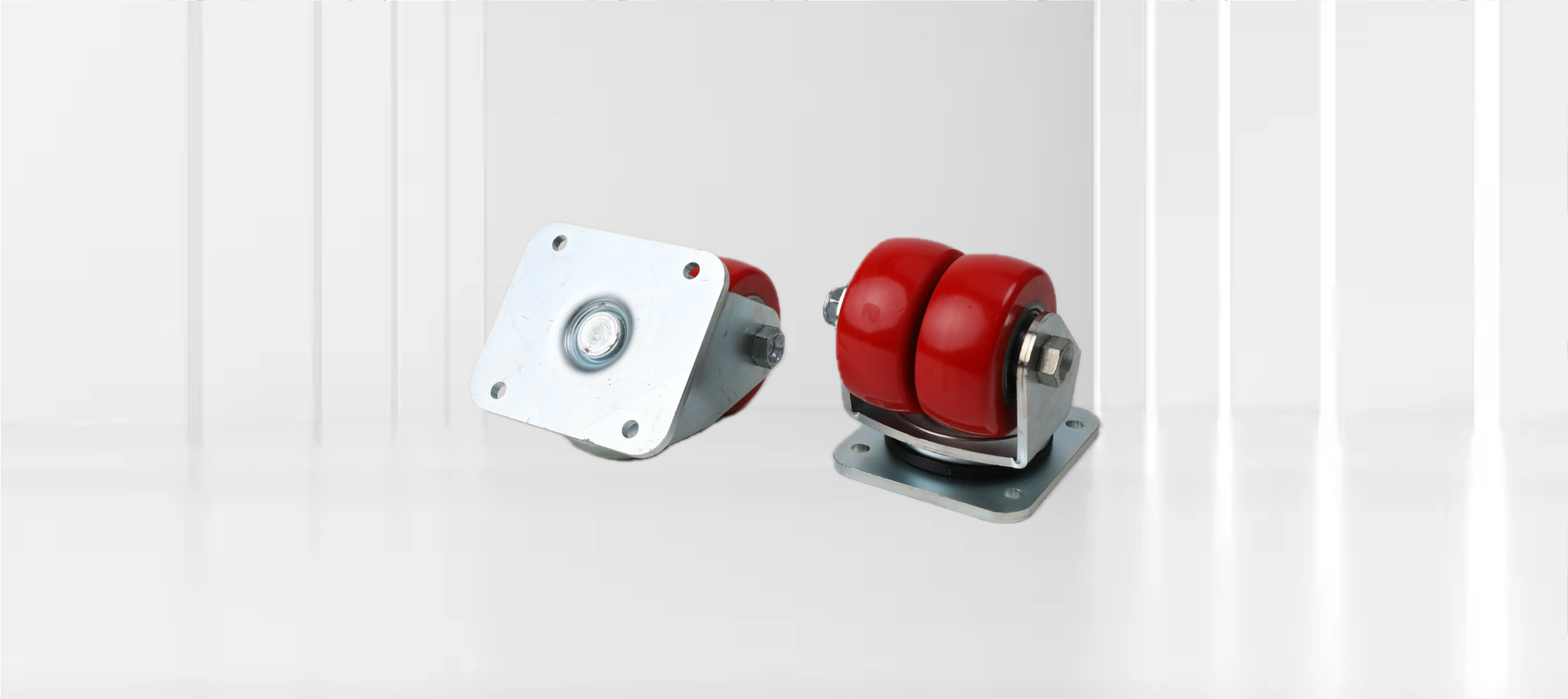
En el diseño profesional de AGV y AMR, una rueda giratoria AGV no es meramente un componente de soporte pasivo.
Desde una perspectiva de ingeniería, participa directamente en el comportamiento mecánico y cinemático del chasis.
Un diseño adecuado de la rueda giratoria afecta:
-
Distribución de la carga
-
Fuerza normal en las ruedas motrices
-
Par de resistencia a la dirección
-
Precisión del control de movimiento
Distribución de la Carga y Equilibrio Mecánico
En una configuración típica de 2 ruedas motrices + 2 ruedas giratorias, una rigidez insuficiente de la rueda giratoria o una precisión de montaje deficiente provocarán una concentración de la carga en las ruedas motrices.
Esto resulta en:
-
Mayor resistencia a la rodadura
-
Mayor par motor continuo
-
Vida útil reducida de la caja de cambios y los rodamientos
Mejores prácticas:
Las ruedas motrices deben soportar entre el 45% y el 55% del peso total del vehículo.
Influencia Cinemática Durante la Dirección
Las ruedas giratorias introducen un par de fricción durante la rotación, especialmente en giros de radio cero.
Una selección deficiente de las ruedas giratorias puede causar:
-
Corriente de giro anormalmente alta
-
Vibración a baja velocidad
-
Desviación de posicionamiento SLAM en AMRs
Factores clave de influencia:
-
Diámetro de la rueda
-
Distancia de desplazamiento
-
Coeficiente de fricción de la banda de rodadura

Parámetros de Selección a Nivel de Ingeniería
| Parámetro | Impacto en la Ingeniería | Recomendación |
|---|---|---|
| Carga nominal | Deformación a largo plazo | ≥ 1.5× carga real |
| Diámetro de la rueda | Superación de obstáculos | ≥ 150 mm para AGVs pesados |
| Dureza de la banda de rodadura | Resistencia a la rodadura | PU 85–95A |
| Distancia de desplazamiento | Autoalineación | Menor para AMRs |
| Tipo de rodamiento | Fiabilidad | Doble bola o cónico |

Coordinación con Ruedas Motrices Servo
Una desalineación entre las ruedas giratorias y las ruedas motrices servo puede llevar a:
-
Sobrecarga de compensación de control
-
Error de odometría basado en codificador
-
Inestabilidad de movimiento a baja velocidad
Reglas de diseño:
-
Diferencia de diámetro dentro de ±5%
-
Materiales de la banda de rodadura unificados
-
Amortiguación controlada del giro para AMRs de precisión
Compartir:
Tracción en el volante vs. tracción diferencial: la elección correcta para su AGV
Solución de integración de ruedas giratorias para AGV con servomotor