

In AGV, AMR, robotic arms, CNC machines, and automated production lines, engineers often face similar motion problems: unstable positioning, obvious noise at high speed, weak torque output, low transmission efficiency, or vibration during start and stop.
In many cases, the problem does not only come from the motor, controller, or system parameters. The gearbox, as the key transmission part between the motor and the machine, also plays an important role in torque output, speed reduction, positioning accuracy, and long-term stability.
As a key part for power transmission, speed reduction, and torque increase, a precision planetary gearbox can directly affect how smoothly and reliably the whole system runs.
Today, from an engineer’s point of view, we will explain how a precision planetary gearbox works and help you understand the core advantages of HKT ROBOT precision gearboxes.

Planetary Gearbox: The Basic Logic Behind It
Many people think a planetary gear reducer is just a simple gear reduction device. Actually, that is not completely true. It is a compact and high-efficiency transmission system. It uses multiple gears working together to reduce motor speed, increase output torque, and make motion more stable.
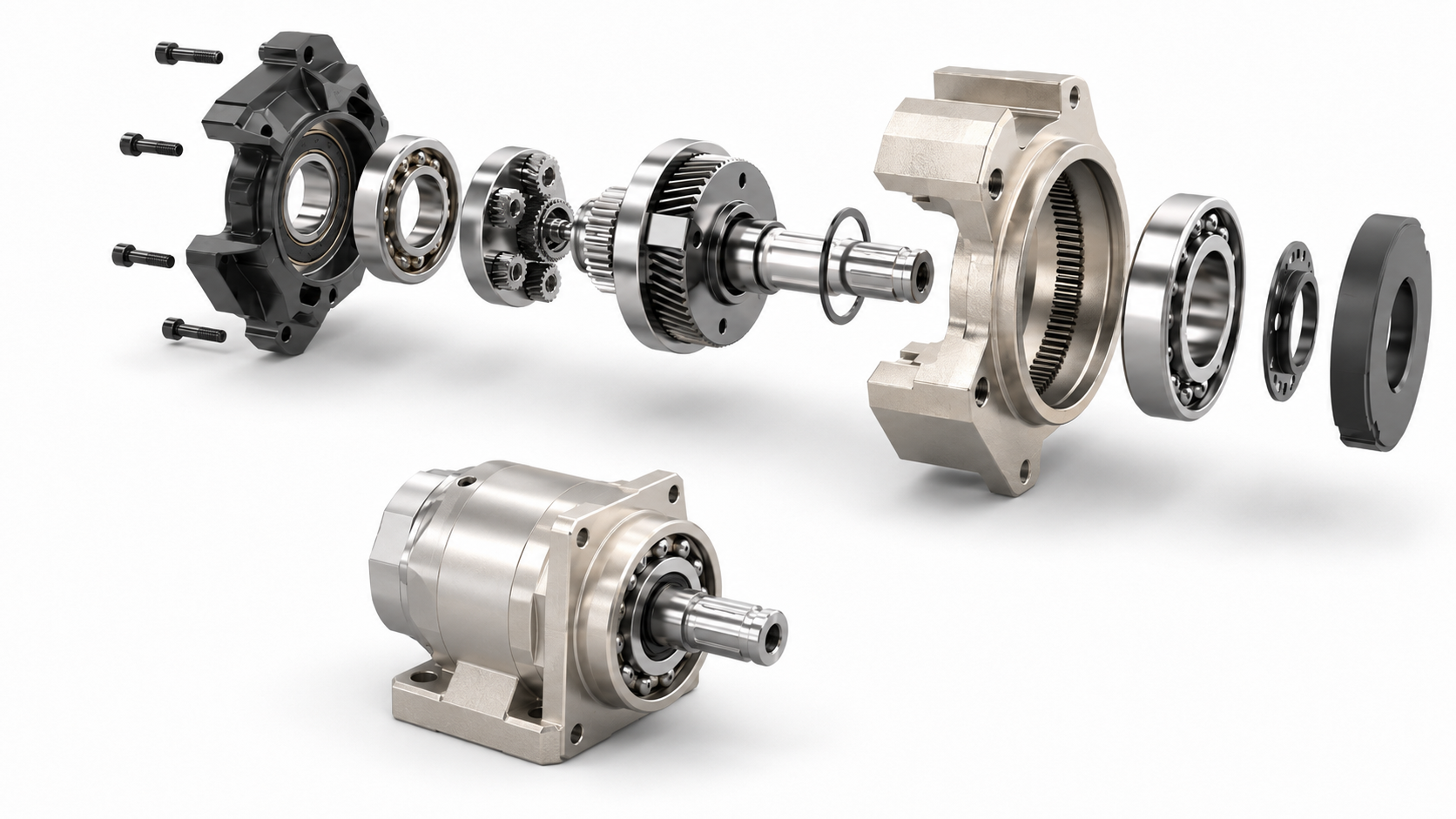
The name “planetary gearbox” comes from a structure similar to the solar system. The sun gear is in the center, the planet gears rotate around the sun gear, the internal ring gear provides a fixed meshing structure, and the planet carrier outputs the final power.
Because of this special structure, planetary gearboxes can provide high torque, compact size, good rigidity, and stable transmission. These features are very important for AGV/AMR vehicles and precision automation equipment.
Main Structure of a Planetary Reducer
A planetary gearbox mainly consists of four key parts. Each part has its own function and works closely with the others.
Sun Gear: This is the power input part. It is connected to the motor output shaft and transfers motor power into the gearbox.
Planet Gears: These are usually three or more gears evenly arranged around the sun gear. They act as the middle transmission parts and mesh with both the sun gear and the internal ring gear.
Internal Ring Gear: This is usually integrated with the gearbox housing. It helps guide the movement of the planet gears and creates a stable meshing structure.
Planet Carrier: This is the output part. It collects the torque transmitted by the planet gears and sends it out to achieve speed reduction and torque increase.
These four parts form a compact coaxial transmission structure. This allows the planetary gearbox to deliver high torque and stable transmission in a small size.

How Does a Planetary Gearbox Work?
When the motor drives the sun gear to rotate at high speed, the planet gears move under the meshing action of both the sun gear and the internal ring gear.
The planet gears rotate around their own axes, and at the same time, they also revolve around the sun gear. Multiple planet gears share the load together and transfer the increased torque to the planet carrier. Finally, the planet carrier provides stable output.
This process gives the planetary gearbox three main functions: reducing output speed, increasing output torque, and improving transmission stability.
For AGV and AMR systems, this is very important. A mobile robot needs stable movement, smooth start and stop, enough torque for load carrying, and reliable operation over long working hours. A suitable planetary gearbox helps support all of these requirements.
Key Advantages of Planetary Gearboxes
Compared with ordinary gear reducers, planetary gearboxes offer several important advantages for AGV/AMR and automation applications.
High Rigidity and Load Capacity
A planetary reducer uses multiple planet gears to share the load, making force distribution more balanced. This gives it higher torque density, stronger load capacity, and better impact resistance.
For AGV/AMR systems, this helps the vehicle start, stop, turn, and carry loads more smoothly. For automation equipment, it helps reduce vibration and improve transmission stability.
Low Backlash and Better Positioning Accuracy
Backlash directly affects positioning accuracy and repeatability. If the backlash is too large, the system may have movement errors or unstable motion.
Precision planetary gearboxes use high-accuracy gear machining, stable bearing support, and precise assembly to control backlash. This makes them suitable for AGV steering modules, robotic arms, CNC machines, and servo-driven automation systems.
Compact Size and High Power Density
AGV/AMR vehicles and automation equipment often have limited installation space. Planetary gearboxes use a coaxial input and output structure, making them compact and easy to integrate with motors, wheels, steering units, and robot joints.
They can provide high torque output in a small size, which makes them ideal for compact motion systems.
Smooth Operation and Lower Noise
For equipment that runs for long hours, smooth transmission and low noise are important. High-precision planetary gearboxes can reduce vibration and running noise through better gear design, machining accuracy, bearing support, and assembly quality.
Helical planetary gearboxes can provide smoother gear meshing, making them suitable for indoor AGV/AMR vehicles, clean workshops, warehouses, medical equipment, and smart factories.
Good Efficiency and Long-Term Reliability
A well-designed planetary gearbox can provide stable transmission efficiency, lower energy loss, and less heat generation. For AGV and AMR vehicles, this also helps support longer working time.
Good gear materials, heat treatment, lubrication, and sealing design can also improve gearbox service life and long-term reliability.
How to Choose a Planetary Gearbox
Choosing a planetary gearbox should be based on the real working conditions, not only the reduction ratio. Engineers need to consider output speed, rated torque, peak torque, backlash, input speed, installation size, load condition, noise, efficiency, and service life. For AGV/AMR systems, vehicle weight, payload, wheel diameter, acceleration, slope, floor condition, and working cycle are also important. A suitable planetary gearbox should match the motor, mechanical structure, and full system requirements to ensure stable and reliable operation.
Conclusion
A planetary gearbox is not just a simple speed reducer. Choosing the right planetary gearbox means choosing a stronger and more reliable foundation for the whole motion system.
Founded in 2013, HKT ROBOT is a transmission solution supplier that focuses on the R&D, design, production, sales, and service of precision gearboxes.
With years of experience in precision transmission technology and manufacturing, we have developed a new generation of precision planetary gearboxes. These gearboxes are designed to solve common problems in automation equipment, such as backlash control, running stability, load capacity, noise reduction, and service life.
They can be widely used in AGV/AMR drive systems, steering wheel modules, lifting mechanisms, and other high-precision automation applications.
Share:
Reliable AGV Motor for AGV/AMR Applications
AGV Caster Wheel Cost: What Affects Pricing and How to Get an Accurate Quote