

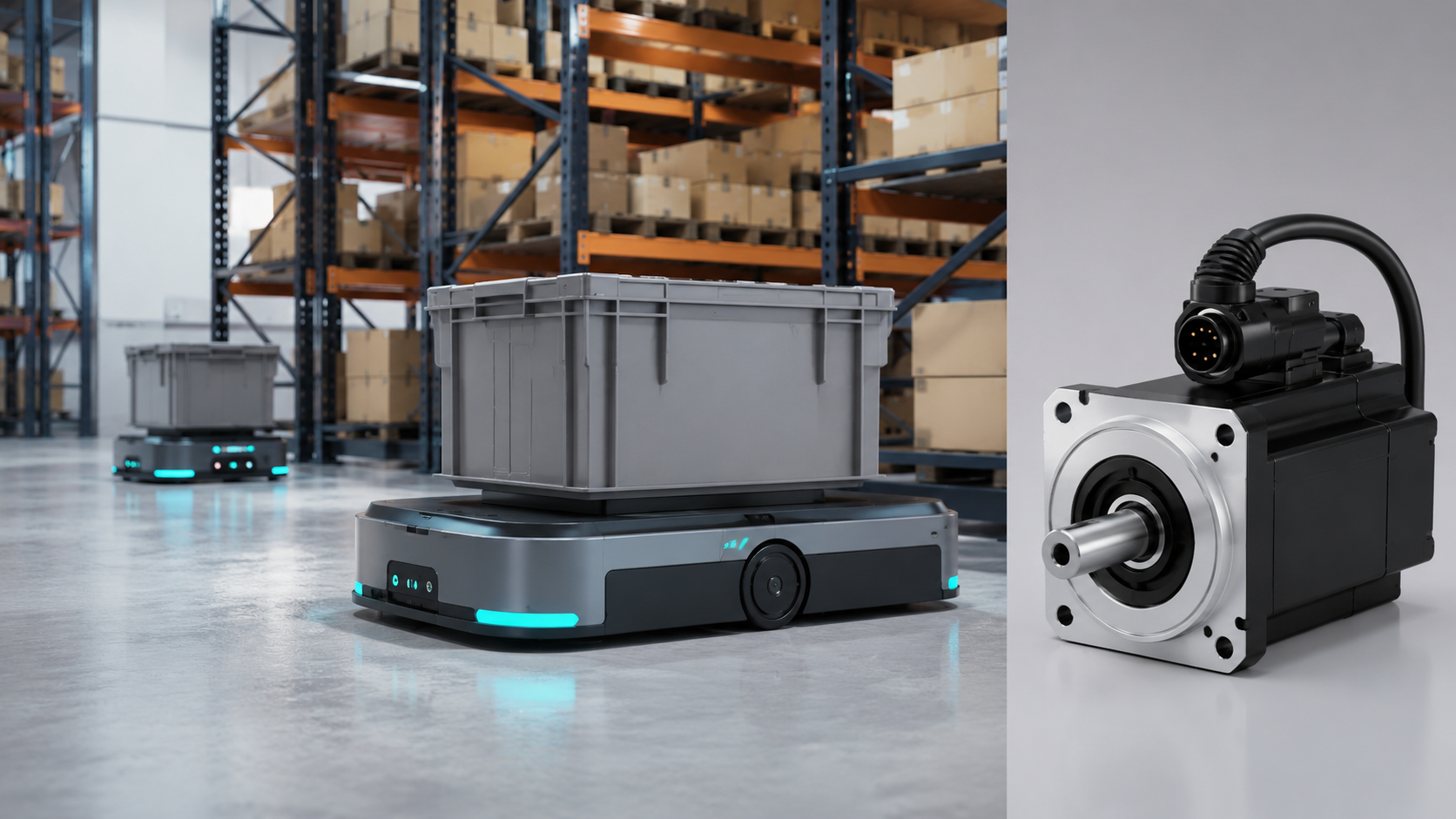

Common AGV Motor Types
BLDC AGV Motor

AGV Servo Motor

AGV Gear Motor
Integrated Wheel Motor
How to Choose the Right AGV Motor
| Selection Factor | Why It Matters |
| Vehicle Weight and Payload | Determines the torque required for starting, acceleration, load handling, and slope climbing. |
| Target Speed | Affects motor speed, reduction ratio, wheel diameter, and overall drive efficiency. |
| Wheel Diameter | Larger wheels usually require higher output torque and different gearbox matching. |
| Torque Requirement | Important for frequent start-stop operation, heavy loads, ramps, and stable low-speed movement. |
| Battery Voltage | Common AGV motor voltage options include 24V and 48V, depending on the vehicle power platform. |
| Brake Requirement | Needed for parking, emergency stop, slope holding, and power-off safety protection. |
| Encoder Feedback | Supports speed control, positioning accuracy, closed-loop control, and wheel synchronization. |
| Control Protocol | CANopen, Modbus, RS485, or other communication methods should match the AGV controller. |
| Installation Space | Motor size, shaft type, flange size, cable outlet, and gearbox structure must fit the vehicle design. |
| Working Environment | Floor condition, dust, water, temperature, duty cycle, and IP rating can affect motor selection. |
Brake, Encoder, and Controller Matching
For many AGV and AMR applications, the motor needs to work with a brake, encoder, gearbox, and controller. A brake helps with parking safety, emergency stop, slope holding, and power-off protection. An encoder provides speed or position feedback for closed-loop control, wheel synchronization, and accurate movement.
HKT ROBOT can support AGV motor configurations with brake options, encoder feedback, reduction ratio matching, and CANopen / Modbus / RS485 communication support. This helps customers match the motor with the real vehicle structure and control system instead of selecting by motor power alone.
AGV Motor Selection by Application
Different AGV and AMR applications require different motor priorities. A compact warehouse AMR usually needs smooth low-speed control, low noise, compact size, and long operating hours. A forklift AGV or heavy-duty platform requires higher torque, stronger braking, reliable encoder feedback, and better gearbox matching.
For 4-way shuttles or narrow-aisle AGVs, fast response, accurate positioning, and compact installation are more important. Therefore, AGV motor selection should be based on the actual vehicle type and working conditions, not only rated power.
Share:
Custom AGV Servo Motor: Specifications, MOQ, and Lead Time Explained
Planetary Gearboxes for AGV/AMR and Automation Systems