

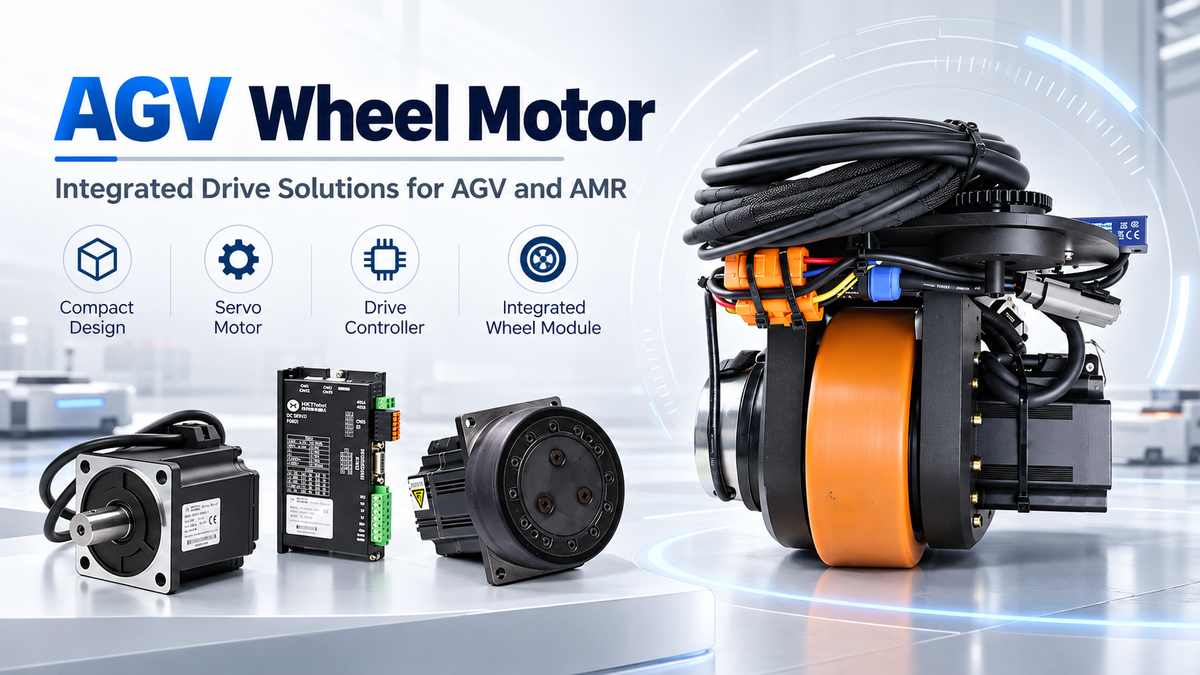
Are you trying to fit a motor, gearbox and drive wheel into an AGV chassis with very little space? Or have you already selected the motor, only to find that the gearbox ratio, wheel diameter or mounting structure does not match?
These are common problems in AGV and AMR projects.
A drive system may look simple on paper, but once the motor, reducer, wheel, brake, encoder and mounting space are considered together, integration becomes much more difficult.
This is where an AGV wheel motor can make the design easier.
At HKT ROBOT, we develop AGV motors, drive wheels, planetary gearboxes and complete drive solutions for different mobile robot platforms. In this blog, we focus on what an AGV wheel motor actually includes, where it works well, and what you should check before choosing one.

What Is an AGV Wheel Motor?
An AGV wheel motor is a drive solution that combines the motor with the wheel-side transmission structure.
Depending on the design, the unit may include:
-
servo motor
-
planetary gearbox or other reducer
-
drive wheel
-
brake
-
encoder
-
bearings and housing
-
mounting flange or bracket
In some designs, the motor and gearbox are fully integrated with the drive wheel. In others, they are assembled as a compact module that can be mounted directly onto the AGV chassis.
The goal is the same: reduce the amount of separate mechanical integration needed around the drive axle.
Why Use an Integrated Wheel Motor Instead of Separate Components?
The biggest reason is packaging.
Space inside an AGV is usually limited. Batteries, lifting mechanisms, controllers, sensors and structural frames all compete for the same space.
If the motor, gearbox and wheel are selected separately, the engineer also needs to consider couplings, shafts, bearing support, mounting brackets and alignment between components.
An integrated AGV wheel motor removes part of this work.
The motor and transmission are already matched around the drive wheel, so the installation becomes more compact and predictable.
This is especially useful for AMRs, latent AGVs and other low-profile mobile robots where installation height is limited.
It can also make maintenance easier. Instead of checking several separate transmission components, the complete drive module can often be removed and replaced as one unit.
Motor, Gearbox and Wheel Need to Work as One System
One common mistake is selecting the motor first and checking the wheel later.
Motor power alone does not determine how the AGV will perform.
Wheel diameter changes the relationship between speed and torque. Gear ratio changes both output speed and available wheel torque. Vehicle weight, acceleration and slope also affect the final drive requirement.
A higher reduction ratio can provide more wheel torque, but it also reduces travel speed.
A larger wheel may improve ground clearance and obstacle crossing, but it also requires more torque to generate the same driving force.
For an integrated wheel motor, the motor, gearbox and wheel should therefore be matched as one system. The complete drive unit needs to provide the required wheel speed and output torque under the actual vehicle load while still fitting the available installation space.
Where AGV Wheel Motors Are Commonly Used
AGV wheel motors are commonly used in compact or modular mobile robot designs.
Typical applications include:
-
warehouse AGVs
-
AMRs
-
under-rack robots
-
material handling robots
-
logistics platforms
-
automated forklifts
-
other industrial mobile robots
They are especially useful when chassis space is limited.
For example, a compact AMR may not have enough room for a long motor shaft, separate gearbox and external wheel support. A wheel-side drive unit can reduce the installation envelope and leave more space for the battery or lifting mechanism.
For larger AGVs, an integrated drive module can also make assembly and replacement easier.

Common AGV Wheel Motor Configurations
Not every AGV wheel motor looks the same.
The structure usually depends on how the vehicle needs to move.
A standard drive wheel combines the motor, gearbox and wheel and is often used in differential-drive mobile robots.
A steering drive wheel adds a steering mechanism, so the wheel can provide both traction and steering. This is common in AGVs that need more flexible movement.
A differential drive unit normally uses two driven wheels and controls direction through the speed difference between them.
These designs use similar drive principles, but their mechanical structure and control requirements are different.
So when someone asks for an “AGV wheel motor,” the first step is often to clarify what type of vehicle movement is required.

AGV Wheel Motor vs a Separate Motor and Drive Wheel
A separate motor layout is still useful in many projects.
It may be a better option when the chassis already has its own shaft, gearbox or wheel support, or when the customer needs to use a specific motor brand or transmission.
An integrated AGV wheel motor is more attractive when installation space is limited and the goal is to reduce couplings, shafts, brackets and other mechanical interfaces.
The integrated structure is also easier to handle as a complete drive module.
What Should You Check Before Choosing an AGV Wheel Motor?
The first step is to look at the vehicle rather than the motor.
Important parameters include:
-
total vehicle weight
-
payload
-
target speed
-
acceleration
-
maximum slope
-
wheel diameter
-
number of drive wheels
-
installation space
-
battery voltage
These parameters determine how much wheel torque and motor power are actually needed.
Wheel material also matters.
Polyurethane is widely used for AGV drive wheels because it offers good load capacity, wear resistance and relatively low noise. But wheel hardness should still match the floor condition and traction requirement.
For compact AMRs, installation height may be the main limitation.
For heavy-duty AGVs, wheel load and continuous torque become more important.
24V and 48V AGV Wheel Motor Options
Most AGV and AMR drive systems use low-voltage DC power.
Common platforms include 24V and 48V.
Smaller mobile robots may use compact 24V motors, while many industrial AGVs and AMRs use 48V servo motors because higher power can be delivered without pushing current too high.
This matters because higher current means more heat and heavier cabling.
Still, voltage should match the battery and controller platform already used on the vehicle.
It should not be selected separately from the rest of the electrical system.
At HKT ROBOT, 24V and 48V are common configurations for our AGV servo and wheel motor solutions. Other voltage options can also be evaluated according to the required motor power, battery system and vehicle design.
Brake and Encoder Options
Many AGV wheel motors can be configured with a brake and encoder.
The brake may be needed when the vehicle has to hold position after power loss or stop safely on a slope.
The encoder provides motor speed and position feedback for the servo system.
These options should be considered early in the drive-system design because they affect the motor structure, control interface and overall vehicle configuration.
AGV Wheel Motor for Low-Profile AMRs
Low-profile AMRs place extra pressure on drive-system packaging.
There may be only a small amount of vertical space under the chassis, especially when the robot also includes a lifting mechanism.
In this type of design, a compact AGV wheel motor can reduce the drive-system footprint.
Motor orientation, gearbox layout and wheel diameter all affect the final installation height.
A horizontal motor arrangement may be useful where height is limited, while other chassis layouts may work better with vertical or offset structures.
The drive system should be selected around the available installation space from the beginning, rather than trying to fit a standard motor into the chassis later.
AGV Wheel Motor for Heavy-Duty Vehicles
For heavier AGVs, the focus shifts from compactness to mechanical load and continuous performance.
The wheel-side bearings and housing carry part of the vehicle weight while the gearbox and motor transmit torque.
A drive unit may provide enough output torque but still be unsuitable if its allowable wheel load is too low.
This makes wheel load capacity an important part of heavy-duty AGV selection.
Continuous torque and thermal performance also matter more as vehicle weight and operating time increase.
Heavy AGVs may start, stop and accelerate hundreds of times during a shift. A motor that performs well during a short test may still run too hot during long operating cycles.
For vehicles running long shifts or 24/7, the motor, gearbox, wheel load and duty cycle should be considered together.
HKT ROBOT: Offering One-stop AGV Wheel Motor Solutions
Founded in 2013, HKT ROBOT focuses on drive components and motion solutions for AGV, AMR and mobile robot systems.
Our product range includes AGV servo motors, steering drive wheels, differential drive units, drive wheels, planetary gearboxes, servo drives, brakes and lifting modules.
For AGV wheel motor applications, we can help match the motor, gearbox and wheel according to the vehicle structure instead of treating each component separately.
This is particularly useful when the project has limited installation space or needs a complete wheel-side drive solution.
Available options can include different motor power levels, 24V / 48V and other voltage options, different reduction ratios, different wheel diameters, brake options, encoder options, and communication interfaces.
Customized drive configurations can also be evaluated for special chassis layouts or operating requirements.
If you are developing an AGV, AMR or mobile robot, please provide the vehicle weight, payload, target speed, wheel diameter, maximum slope, battery voltage and available installation space. A chassis or installation drawing is also helpful. Our team is always ready to help you.
FAQs for AGV Wheel Motor
1. Can HKT ROBOT customize the AGV wheel motor?
Yes. We can customize motor power, gearbox ratio, wheel diameter, voltage, brake, encoder, mounting structure and other details according to your vehicle design.
2. What is the typical lead time for an AGV wheel motor?
Lead time depends on the model, quantity and customization requirements. Usually about 20 to 30 days. Standard models are usually faster, while custom configurations need additional engineering and production time.
3. How long does an AGV wheel motor last?
The motor is designed to have a life of 20,000 hours. Service life depends on load, duty cycle, floor condition, operating speed and maintenance. Proper selection and regular inspection can help extend the life of the motor, gearbox, bearings and wheel.
4. What maintenance does an AGV wheel motor need?
Regularly check wheel wear, abnormal noise, bearings, mounting bolts, cables and gearbox condition. For vehicles running long hours, inspection should be more frequent.
5. What after-sales support does HKT ROBOT provide?
We can support model selection, installation, parameter matching and troubleshooting. If a problem occurs, photos, videos and alarm information can help our engineers identify the cause faster.
6. Can you replace an existing AGV wheel motor?
Yes. Please provide the current model, installation dimensions, wheel diameter, voltage, motor power and gearbox ratio. Drawings or photos are very helpful.
7. Can I order a sample before batch production?
Yes, sample or small-quantity orders can be arranged for testing and vehicle validation, depending on the model and customization requirements.
Share:
AGV/AMR Gearbox Types and Selection Guide