

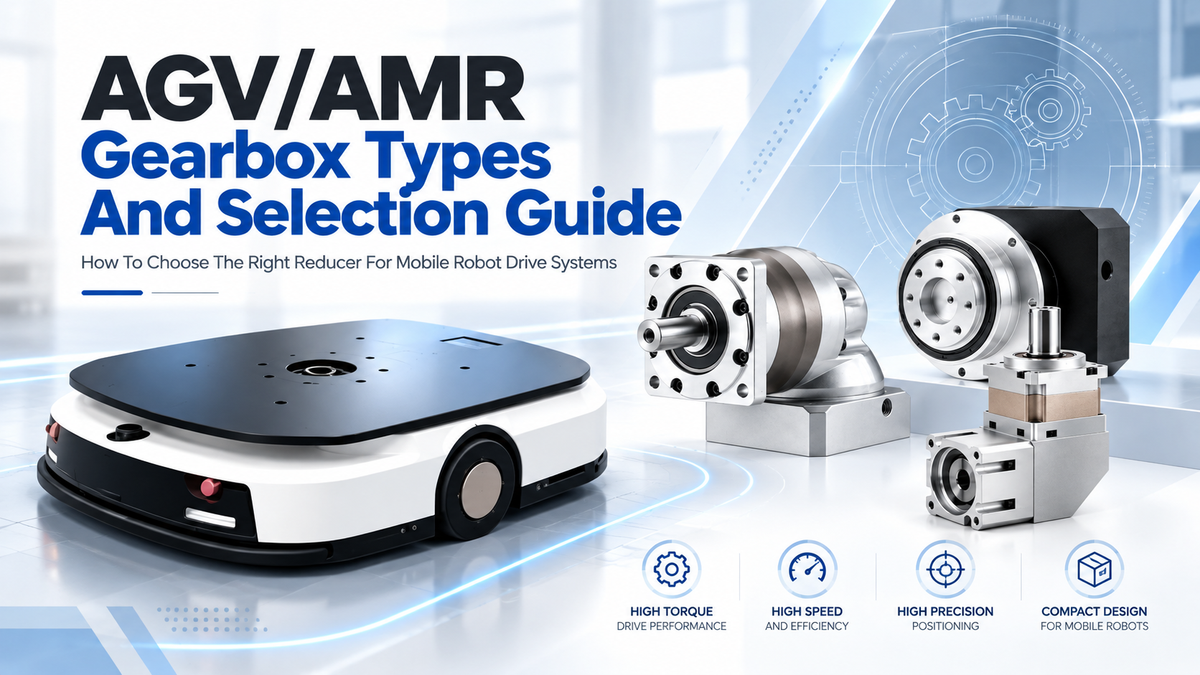
A gearbox is a very important part of an AGV or AMR drive system. It is often used in drive wheels, steering wheels, lifting or rotating mechanisms. Its main job is to reduce motor speed, increase output torque, and make the motor work better with the actual load.
For mobile robots, simply using a bigger servo motor is not always the most practical or cost-effective way to get more driving force. This is especially true for heavy loads, low-speed movement, or applications with frequent start and stop cycles.
With the right AGV gearbox or AGV reducer, the system can increase wheel torque without making the motor much larger or more powerful.
So an AGV reducer does much more than just reduce speed. The gear ratio, output torque, installation size, backlash, radial load capacity, and efficiency can all affect vehicle speed, load capacity, control accuracy, and running stability.

(60mm flange plantary gearbox)
Why Do AGVs and AMRs Need Gearboxes?
AGVs and AMRs have some special requirements that are different from many normal industrial machines.
The first issue is space.
Mobile robots usually need a low chassis. This is especially true for low-profile AMRs, underride robots, and compact steering drive systems. The space for the motor and gearbox can be very limited.
The drive wheel itself is also usually not very large, so the gearbox needs to provide enough reduction and torque in a compact size.
This is one reason why planetary gearboxes for AGVs are widely used. They can provide high torque in a relatively small package.
The second issue is wheel-side load.
In many AGV systems, the gearbox is installed very close to the drive wheel, or even integrated into the wheel structure. So the output side may not only transmit torque. It may also carry part of the vehicle weight.
Because of this, the output bearing, housing stiffness, and wheel mounting design are all important.
AGVs also start, accelerate, slow down, stop, reverse, and turn many times during normal operation.
This kind of working cycle puts repeated loads on the gears and bearings. If the gearbox has too much backlash or poor gear engagement, it may affect low-speed movement, steering response, and repeat positioning.
For this reason, an AGV reducer normally needs a good balance of compact size, high torque density, good efficiency, low backlash, radial load capacity, and long-term reliability.
Common Gearbox Types for AGVs and AMRs
From the transmission structure, planetary gearboxes are still one of the most common choices for AGVs and AMRs.
In some special applications, cycloidal, parallel-shaft, or worm gear structures may also be used.
Planetary Gearbox
A planetary gearbox is mainly made of a sun gear, planet gears, ring gear, and planet carrier.
Because several planet gears share the load, the gearbox can transmit relatively high torque while keeping the size compact.
The main advantages are simple:
-
Compact structure
-
High transmission efficiency
-
Good rigidity
-
High torque density
-
Low-backlash options
-
Easy integration with servo motors
Because of this, a planetary gearbox is widely used in AGV drive wheels, steering systems, wheel hub drives, lifting mechanisms, and other servo motion systems.
A planetary gearbox for servo motor applications can also be designed with different layouts depending on the available space.
For example, a standard inline planetary gearbox works well when there is enough axial space.
If the AGV has limited space, a right angle planetary gearbox can change the motor installation direction and help reduce the total length of the drive system.
For low-profile AGVs, an agv 90 degree gearbox can be very useful because the motor and output shaft do not need to stay on the same line.
A wheel hub planetary reducer goes one step further by placing the reduction system closer to, or inside, the wheel. This shortens the whole drive structure and can help save installation space.
These designs look different, but they are still based on planetary gear transmission.
For projects that need better accuracy, a precision planetary reducer can be used to reduce backlash and improve steering or positioning performance.
Some servo applications also use a helical planetary reducer to improve running smoothness and gear engagement.

Cycloidal Reducer
A cycloidal reducer uses a cycloidal disc and pin structure for transmission.
It can provide a large reduction ratio and high torque in a relatively compact size. It also has good rigidity and shock resistance.
Compared with a standard planetary gearbox, a cycloidal reducer can be useful in applications that need a high ratio, high rigidity, or high torque.
It may be used in some robot rotating units, steering systems, or heavy-duty mechanisms.
However, the design, machining accuracy, bearing structure, assembly quality, vibration, and noise all need to be considered.
So a cycloidal reducer is not always the first choice for normal AGV drive wheels.
Parallel-Shaft Gear Reducer
A parallel-shaft reducer usually uses several stages of spur or helical gears.
The structure is mature and relatively simple to manufacture. It can still be a good option when there is enough space and the project is more cost-sensitive.
However, when an AGV needs a higher reduction ratio and a compact size at the same time, a multi-stage parallel-shaft design can become larger.
That is why planetary structures are often more suitable for compact AMRs.
Other Reducer Types
Some AGV lifting units, adjustment mechanisms, or low-frequency motion systems may also use worm gear reducers.
A worm gear structure can provide a large reduction ratio and can also make a 90-degree transmission.
Some designs can provide a self-locking effect.
However, worm gear efficiency is usually lower than that of a planetary gearbox, and heat can become more noticeable during long continuous operation.
There are also other precision reducers, such as the harmonic reducer, harmonic drive, and RV reducer.
These are more common in robotic joints, precision rotating axes, or other high-accuracy mechanisms. They are not the main choice for normal AGV wheel drive systems.
So there is no single “best” gearbox for every AGV.
For most AGV drive systems, planetary gearboxes are still a common choice because they offer a good balance of efficiency, size, torque, and cost.
Other gearbox types are used when the application needs a special ratio, layout, load capacity, or motion function.
How to Choose the AGV Gear Ratio
The gear ratio is one of the most important parameters when choosing an AGV reducer box, but it cannot be selected by itself.
The target vehicle speed, wheel diameter, and motor speed are directly related.
Normally, we first calculate the wheel speed based on the target vehicle speed and wheel diameter, and then calculate the gearbox ratio from the motor speed.
The wheel speed can be estimated by:
n = 60v πD
Where:
- v = AGV speed in m/s
- D = drive wheel diameter in meters
- n = wheel speed in rpm
For example, if an AGV uses a 210 mm drive wheel and the target speed is 1 m/s, the wheel speed is around 91 rpm.
If the servo motor rated speed is 3000 rpm, the theoretical ratio is:
[3000÷91≈33]
So a ratio around 30:1 or slightly above can be a reasonable starting point.
But the final selection cannot be based only on this number.
You still need to consider the actual motor speed, maximum vehicle speed, starting torque, slope, acceleration, gearbox efficiency, and available standard ratios.
Why Not Just Reduce the Motor Speed?
There is a common issue in AGV drive systems.
The drive wheel is usually not very large, but the servo motor rated speed is often quite high.
Many servo motors run at around 3000 rpm, while AGVs normally travel at a much lower speed.
If the drive wheel diameter is around 150 to 380 mm, the required gear ratio may cover quite a wide range.
But a standard gearbox cannot always provide a high ratio and still keep a very compact size.
Because of this, some AGVs simply reduce the actual servo motor speed to control the vehicle speed.
This can work, but it may not be the best solution.
If the motor runs for a long time far below its rated speed, it may not operate in its best efficiency range. Continuous torque, heat, and overall energy use may also be less ideal.
Another solution is to use more reduction stages.
This can provide a higher gear ratio, but more stages can also increase the gearbox length, structure complexity, and cost.
So for an AGV or AMR, the goal is not simply to get the biggest possible ratio.
A good servo reducer or servo gearbox should find a balance between gear ratio, size, efficiency, output torque, and cost.
Output Torque and Gear Ratio Need to Be Considered Together
A higher reduction ratio can increase output torque, but a higher ratio is not always better.
The gearbox output torque can be roughly estimated by:
-
Tout = Tmotor × i × η
Where:
- Tmotor = motor torque
- i = gear ratio
- η = gearbox efficiency
- Tout = output torque
If the ratio becomes larger, wheel torque increases, but the maximum output speed becomes lower.
For a high-speed AMR, too much reduction may limit top speed.
For a heavy-duty AGV, too little reduction may not provide enough wheel torque.
So both rated torque and peak torque need to be checked.
During normal constant-speed travel, the AGV may not need much torque.
But during startup, acceleration, climbing, obstacle crossing, or sudden load changes, the torque demand can increase a lot.
If a servo motor gear box is selected only based on normal running torque, long-term use may lead to gear wear, increased backlash, or too much bearing load.
Installation, Radial Load, and Accuracy Also Matter
Gearbox selection is not only about ratio and torque.
The installation structure also matters.
For a drive wheel, the gearbox output side may directly carry part of the vehicle weight. So radial load capacity is very important.
If the wheel is mounted far away from the gearbox bearing, the load on the output bearing becomes even higher.
For steering systems, backlash also becomes important.
If the gearbox has too much backlash, steering response may become slower, and low-speed control or repeat positioning may become less stable.
In this case, a precision planetary gearbox or a low-backlash servo gear box can be more suitable.
For lifting systems, the main points are different. Output torque, holding ability, duty cycle, and shock load are often more important.
So even if two gearboxes have the same ratio and rated torque, they may not be equally suitable for the same AGV.
The mounting size, output shaft design, radial load, backlash, and duty cycle all need to be checked.
HKT ROBOT Gearbox Solutions for AGVs and AMRs
Founded in 2013, HKT ROBOT has been committed to providing one-stop solutions for AGVs and AMRs, including AGV servo motors, gearboxes, drive wheels, steering drive wheels, differential drive units, and more, earning the trust of customers worldwide.
Due to the limited space available for wheels and the high rotational speed of motors, simply increasing the number of reduction stages would make the gearbox larger and increase the cost. Therefore, we focus on achieving the best match between motor speed, gear ratio, wheel-end torque, and installation space.
Our gearboxes feature extremely low backlash, down to 3 arcmin, delivering high-precision transmission performance. Their compact and lightweight structure is ideal for limited installation spaces, while the high torque density enables them to handle heavy loads and complex operating conditions. The design life can reach up to 20,000 hours, with a maintenance-free and easy-to-use design. In addition, the gearboxes offer high compatibility with different servo motors and can provide up to IP65 protection against water and dust according to demanding operating environments and conditions, ensuring stable long-term operation.
For different drive wheels, steering wheels, and hub structures, we comprehensively consider factors such as motor rated speed, wheel diameter, target vehicle speed, load, and available space in order to match the most suitable gearbox.
If you are starting a new AGV project and need a planetary gearbox, send us your vehicle weight, payload, target speed, wheel diameter, and available installation space. Our team is available 24/7 to help you select the right gearbox for your application.
Conclusion
The gearbox is a key part between the motor and the final load in an AGV or AMR drive system.
A good gearbox does more than reduce speed.
It helps the motor work in a more suitable speed range while providing the required wheel torque and meeting the vehicle requirements for speed, space, accuracy, load, and efficiency.
For most AGV and AMR drive systems, planetary gearboxes are still a very common choice because they offer a good balance of torque density, transmission efficiency, compact size, and easy servo motor integration.
For applications that need a higher ratio, higher rigidity, or a special structure, cycloidal, parallel-shaft, worm gear, harmonic, or RV reducers may also be considered.
The final gearbox selection should always be based on the whole drive system.
The motor, gearbox, wheel diameter, vehicle load, speed, and installation space should be matched together.
HKT ROBOT provides AGV/AMR planetary gearboxes, wheel hub reducers, servo motors, drive wheels, steering units, and related drive systems.
If you are developing a new AGV or AMR project, you can send us the vehicle weight, payload, target speed, wheel diameter, slope, motor parameters, and installation size. We can help check the required gear ratio and drive configuration.
Share:
AGV Drive Wheels for Forklift AGVs
AGV Wheel Motor: Integrated Drive Solutions for AGV and AMR