

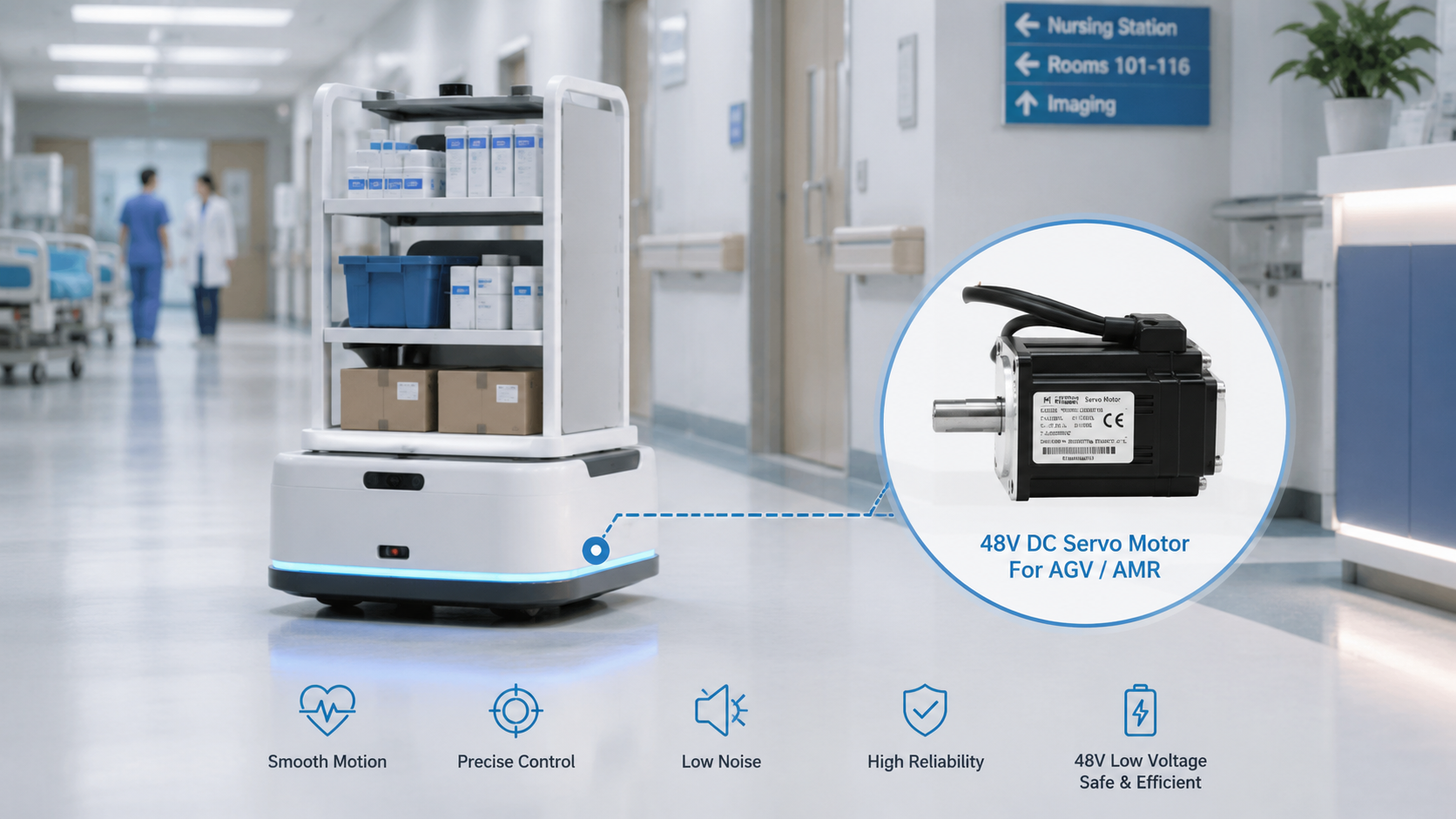
As AGV and AMR applications grow in warehouses, factories, hospitals, logistics centers, and heavy-duty mobile platforms, the drive system is no longer just about making the vehicle move. It must support smooth start and stop, accurate steering, stable load response, and long working hours.
This is why 48V DC servo motors are widely used in mobile robot systems. For many AGV and AMR projects, 48V offers a practical balance between power output, current control, wiring size, battery compatibility, system safety, and integration cost.
For AGV and AMR engineers, choosing a 48V motor is not only about selecting a motor. It is about matching the full drive system, including the motor, servo drive, gearbox, wheel module, battery, controller, communication protocol, and wiring design.

What Is A 48V DC Servo Motor?
A 48V DC servo motor is a low-voltage motor used for precise speed, torque, and position control. It usually works with a servo drive and encoder feedback to form a closed-loop control system.
For AGV and AMR systems, this closed-loop control is important because the vehicle often needs to start, stop, turn, reverse, accelerate, decelerate, and respond to load changes. A suitable 48V DC servo motor helps the mobile robot move more smoothly and maintain better motion stability.
Why Is 48V Common In AGV And AMR Systems?
48V is common in AGV and AMR systems because it fits many battery-powered mobile robot platforms and provides a good balance between safety, power, efficiency, and wiring design.
In simple terms, when the output power is the same, a higher voltage can reduce current. Compared with 24V systems, 48V can help control current, reduce cable heating, and improve system efficiency. This is useful for AGVs and AMRs because the vehicle body often has limited space, long wiring paths, frequent load changes, and long operating hours.
However, 48V is not always “better” for every project. For very heavy-duty AGVs or very high-power systems, engineers still need to consider current, cable size, heat dissipation, driver capacity, battery design, and working cycle. The best choice depends on the full vehicle design.
48V Vs 24V Motor For AGV: Which Is Better?
For small mobile robots or light-duty equipment, 24V motors may be enough. But when the AGV or AMR needs higher power, stronger torque, longer working time, or more stable motion under load, 48V is often a better choice.
A 48V system can reduce current compared with a 24V system at the same power level. This helps make wiring and thermal management easier. It can also support stronger acceleration, better load response, and more stable operation in many AGV/AMR applications.
For this reason, 48V DC servo motors are commonly used in AGV drive wheels, AMR drive modules, steering wheel modules, logistics sorting equipment, parking robots, stacking machines, and mobile platforms.

What Specs Matter When Choosing A 48V AGV Motor?
Choosing a 48V AGV motor should be based on the full vehicle system, not only motor power.
The most important selection factors include:
| Selection Factor | Why It Matters |
| Vehicle Load And Payload | Determines the required torque and motor power. |
| Wheel Diameter | Affects output speed, torque demand, and gearbox matching. |
| Target Speed | Helps define motor speed, reduction ratio, and drive requirements. |
| Slope Requirement | Higher slope requires stronger torque and overload capacity. |
| Acceleration And Braking | Affects peak torque and servo response. |
| Working Cycle | Long operating hours require better heat control and reliability. |
| Gearbox Ratio | Impacts speed, torque, and motion stability. |
| Encoder And Brake | Important for positioning, safety, and holding force. |
| Communication Protocol | CANopen or other protocols affect system integration. |
| Installation Space | Determines motor size, flange, shaft, and cable layout. |
A compact AMR may need a small, low-noise, easy-to-integrate motor. A heavy-duty AGV may need higher torque, stronger overload capacity, better heat management, and a matched servo drive solution.
Why Choose HKT ROBOT 48V DC Servo Motors?
HKT ROBOT provides 48V low-voltage servo motor solutions for AGV, AMR, mobile robots, logistics equipment, parking robots, stacking machines, and heavy-duty mobile platforms.
Our product range includes ultra-short low-voltage motors from 400W to 15kW and high-power DC servo motors from 1.5kW to 30kW. This allows us to support both compact mobile robots and heavy-duty AGV applications.
For AGV/AMR projects, motor performance directly affects acceleration, steering stability, load response, braking, noise, and long-term reliability. HKT ROBOT servo motors are designed for high torque, low noise, rapid response, and stable closed-loop control.
We also support CANopen/Modbus, matched servo drives, and customization of flange, shaft, and cable length, helping customers build easier-to-integrate and more reliable AGV/AMR motion systems.
How To Choose The Right 48V Servo Motor For AGV Drive Systems?
To choose the right 48V servo motor, customers should provide the key vehicle and application data first. This helps engineers calculate the required torque, speed, power, gearbox ratio, and drive configuration.
Useful information includes:
-
Vehicle weight
-
Payload
-
Target speed
-
Wheel diameter
-
Slope requirement
-
Acceleration requirement
-
Working cycle
-
Installation space
-
Brake requirement
-
Encoder requirement
-
Communication protocol
-
Battery voltage platform
With this information, HKT ROBOT can help recommend a suitable 48V DC servo motor, servo drive, gearbox, and wheel module solution for the AGV/AMR system.
FAQ
Why Do AGVs Use 48V Motors?
AGVs use 48V motors because 48V provides a good balance between power output, current control, battery compatibility, safety, and integration cost. It is widely used in battery-powered mobile robot systems.
Is A 48V Motor Better Than A 24V Motor For AGV?
For higher-power AGV and AMR applications, 48V is often better than 24V because it can reduce current at the same power level, helping control cable heating, voltage drop, and system loss.
What Is A 48V DC Servo Motor Used For?
A 48V DC servo motor is used for precise speed, torque, and position control in AGV drive wheels, AMR drive modules, steering systems, lifting mechanisms, and other mobile robot motion systems.
What Information Is Needed For Motor Selection?
Vehicle load, payload, speed, wheel diameter, slope, acceleration, working cycle, installation space, gearbox ratio, brake requirement, encoder type, and communication protocol are important for 48V AGV motor selection.
Can HKT ROBOT Provide Matched Servo Drives?
Yes. HKT ROBOT can provide matched servo drives, CANopen or Modbus support, gearbox matching, and customized motor options for AGV and AMR drive systems.
If you are developing an AGV, AMR, mobile robot, logistics vehicle, or heavy-duty mobile platform, send us your vehicle load, payload, target speed, wheel diameter, slope requirement, installation space, and control requirements. HKT ROBOT can help you select the right 48V DC servo motor and matched drive solution for your project.
Share:
AGV Caster Wheel Cost: What Affects Pricing and How to Get an Accurate Quote
Horizontal Steering Drive Wheels for Efficient and Stable AGV/AMR Operation