

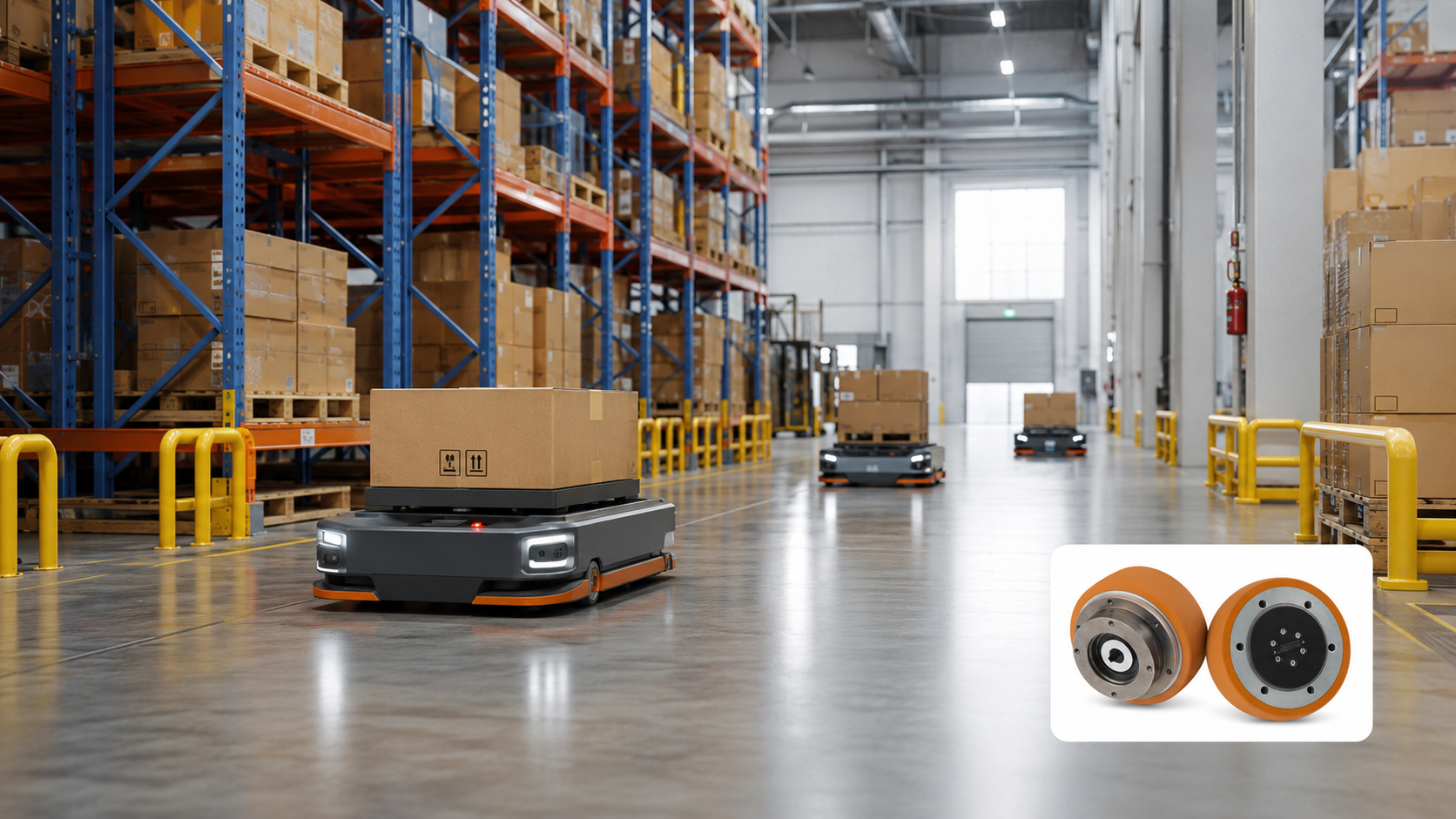
En aplicaciones de logística de almacén, los robots AGV y AMR necesitan más que un movimiento básico. Necesitan tracción estable, frenado seguro, manejo fiable de la carga, bajo nivel de ruido y largas horas de funcionamiento con un tiempo de inactividad mínimo. Las ruedas motrices de los AGV son uno de los componentes clave que afectan directamente a este rendimiento.
Por lo tanto, la selección de la rueda motriz del AGV debe partir de la aplicación real, incluyendo la carga, el estado del suelo, la velocidad, el material de la rueda y el acoplamiento del sistema de transmisión, en lugar de solo de una lista de productos estándar.

¿Qué son las ruedas motrices de los AGV?
Las ruedas motrices de los AGV son las ruedas con motor que proporcionan tracción y movimiento a los AGV y AMR. A diferencia de las ruedas giratorias pasivas de los AGV, que principalmente soportan el vehículo y siguen su movimiento, las ruedas motrices de los AGV están directamente conectadas al sistema de movimiento y afectan la aceleración, el frenado, el manejo de la carga y la estabilidad de funcionamiento.
En las aplicaciones de logística de almacén, una rueda motriz de AGV puede utilizarse como una unidad independiente o como parte de un módulo de rueda motriz integrado con un motor, una caja de cambios, un freno, un codificador y una estructura de montaje. Su rendimiento depende no solo del tamaño de la rueda, sino también de la capacidad de carga, el material de la rueda, el estado del suelo, la salida de par y la compatibilidad del sistema.

Por qué las ruedas motrices de los AGV son importantes en la logística de almacén
Los robots de almacén a menudo trabajan en condiciones de arranque y parada repetidas. Mueven palets, estanterías, cajas de material, componentes o productos terminados entre áreas de almacenamiento, estaciones de preparación de pedidos, líneas de montaje, zonas de carga y áreas de clasificación.
En estas condiciones de trabajo, las ruedas motrices de los AGV determinan directamente la tracción durante la aceleración y el frenado, así como la capacidad de carga bajo movimiento dinámico. Su rendimiento afecta profundamente la estabilidad de posicionamiento en los puntos de acoplamiento y los niveles de ruido en entornos interiores. Además, está estrechamente relacionado con el desgaste de las ruedas y la frecuencia de reemplazo, la protección del suelo y los costos generales de mantenimiento, lo que significa que incluso si una rueda motriz funciona perfectamente en una prueba a corto plazo, aún puede crear problemas sistémicos después de una operación a largo plazo si la carga real, las condiciones del suelo, la velocidad y el ciclo de trabajo no se consideran de manera completa y adecuada.
Factores clave al elegir ruedas motrices para AGV
Capacidad de carga: Más que un número estático
La capacidad de carga es importante, pero no debe tratarse como un número fijo único. Una rueda clasificada para una cierta carga estática aún puede fallar en el funcionamiento real del AGV si no se consideran las condiciones dinámicas.
Al seleccionar ruedas motrices para AGV, el cálculo debe incluir:
-
Peso propio del AGV
-
Carga útil máxima
-
Número de ruedas motrices y ruedas de apoyo
-
Distribución del peso y centro de gravedad
-
Aceleración y frenado de emergencia
-
Condiciones de pendiente o rampa
-
Margen de seguridad para el funcionamiento a largo plazo
Para AGV o AMR de servicio pesado, la rueda motriz debe proporcionar suficiente tracción bajo carga, no solo soporte estático.
Material de la rueda y protección del suelo
El material de la rueda afecta la tracción, la resistencia al desgaste, el ruido, la resistencia a la rodadura y la protección del suelo.
| Material de la rueda | Características comunes | Uso adecuado |
| Poliuretano | Resistente al desgaste, bajo nivel de ruido, buena protección del suelo | La mayoría de los AGV de almacén interiores |
| Caucho | Buen agarre y absorción de impactos | Aplicaciones que necesitan mayor tracción |
| Metal | Alta resistencia, menos elástico | Entornos especiales de servicio pesado o duros |
Para la mayoría de las aplicaciones de logística de almacén interiores, las ruedas de poliuretano se utilizan comúnmente porque proporcionan un buen equilibrio entre durabilidad, protección del suelo y estabilidad de funcionamiento.
Sin embargo, el mejor material aún depende del tipo de suelo, la carga, la velocidad y el ciclo de trabajo.
Compatibilidad con el suelo
Los suelos de los almacenes pueden incluir suelos de epoxi, suelos de hormigón, suelos antiestáticos o superficies industriales pulidas. Cada suelo crea diferentes condiciones de fricción y desgaste.
Una rueda motriz AGV adecuada debe proporcionar un agarre estable sin causar un desgaste excesivo ni daños en el suelo. Esto es especialmente importante en pasillos estrechos, zonas de preparación de pedidos, estaciones de transferencia y puntos de acoplamiento, donde el AGV necesita detenerse con precisión y repetir el mismo movimiento muchas veces al día.
Estructura de accionamiento y adaptación del sistema
Las ruedas motrices de AGV deben coincidir con todo el sistema de accionamiento. Un módulo completo de rueda motriz de AGV puede incluir la rueda en sí, un motor, una caja de cambios, un freno, un codificador, la estructura de montaje y un controlador de accionamiento compatible.
Para proyectos de automatización de almacenes, un módulo de rueda motriz integrado puede reducir el trabajo de diseño y simplificar la instalación. Pero el módulo aún necesita coincidir con la carga del AGV, la velocidad objetivo, el diámetro de la rueda, la potencia del motor, la relación de engranajes, el requisito de freno y el método de control.
Si la potencia del motor es demasiado pequeña, el AGV puede tener dificultades durante la aceleración o en pendientes suaves. Si la relación de transmisión no es adecuada, el vehículo puede perder par o velocidad. Un sistema de ruedas motrices bien adaptado ayuda a que el AGV funcione con mayor suavidad y reduce la tensión en cada componente.
Soluciones de ruedas motrices AGV de HKT ROBOT
Para aplicaciones de logística de almacén de AGV/AMR, HKT ROBOT ofrece ruedas motrices AGV, módulos de ruedas motrices, servomotores, servodrives, reductores y componentes de sistemas de movimiento relacionados.

En lugar de seleccionar una rueda solo por su tamaño o capacidad de carga, HKT ROBOT admite la adaptación de ruedas motrices según la carga, la velocidad, el estado del suelo, el espacio de instalación, la potencia del motor, la relación de engranajes, los requisitos de freno y el método de control.
Además de los componentes estándar, también ofrecemos soluciones personalizadas de ruedas motrices basadas en los requisitos específicos del proyecto AGV/AMR, incluyendo el diámetro de la rueda, el material de la rueda, la estructura de montaje, la configuración del motor, la relación de la caja de cambios y el diseño del módulo de accionamiento integrado.
¿Busca una solución de rueda motriz adecuada para su proyecto AGV o AMR? Póngase en contacto con HKT ROBOT para analizar sus requisitos de carga, velocidad, estado del suelo y sistema de accionamiento.
Compartir:
Configuraciones comunes de volantes de AGV para AGV y AMR
Guía Técnica de Ruedas para AGV para Sistemas AGV/AMR