

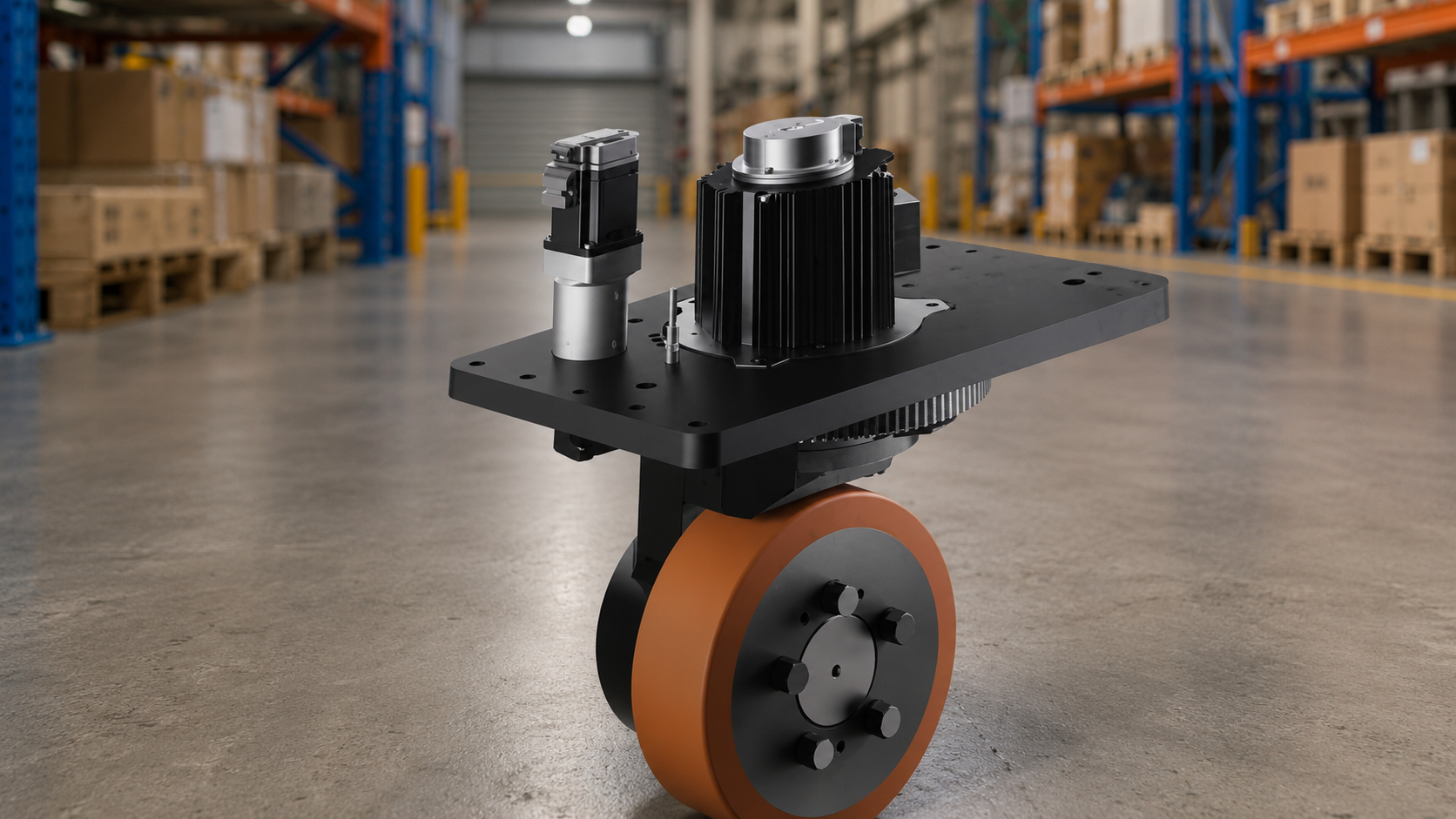
AGV and AMR chassis design is often limited by space. The battery, controller, sensors, lifting mechanism, and drive system all need to fit inside one vehicle. When the chassis is narrow or the internal layout is crowded, a vertical drive wheel can provide a more flexible solution.

What Is a Vertical Drive Wheel?
A vertical drive wheel is an integrated drive module that combines traction, steering, and load support. The drive motor is installed vertically, while a separate steering motor controls the wheel angle.
Because both driving and steering functions are built into one module, the wheel can change direction independently. When several modules work together, the AGV can move forward, reverse, turn, rotate in place, and, depending on the wheel layout and control system, move sideways.
How the Vertical Wheel Drive Saves Chassis Space
The main advantage of the vertical structure is its smaller horizontal footprint.
In a horizontal drive module, the traction motor, gearbox, and steering mechanism are arranged across the chassis plane. This creates a lower overall height, but the module may take up more space around the wheel.
A vertical structure places these components upward instead. This can free up horizontal space for:
-
Batteries and controllers
-
Lifting or rotating mechanisms
-
Cable routing
-
Sensors and safety components
-
Additional steering or support wheels
This layout is useful when the AGV is narrow, when several steering modules must be installed, or when the chassis contains many functional components.
A steerable vertical drive wheel can also simplify modular chassis design. Engineers can place one, two, or four steering units in different positions without allowing the traction motor to extend too far across the chassis.

Where Does a Vertical Steering Drive Unit Work Best?
Heavy-Duty AGVs and Forklift Robots
Heavy-duty vehicles need strong traction, sufficient steering torque, and stable load support. A vertical structure provides more room for larger motors, gearboxes, bearings, and steering components.
This makes it suitable for forklift AGVs, pallet transport vehicles, industrial carts, and heavy material-handling platforms.
Narrow Chassis and Limited Horizontal Space
Some warehouse vehicles must travel through narrow aisles or work between closely placed machines. In these cases, reducing vehicle width can be more important than reducing vehicle height.
A vertical steering wheel occupies less space around the chassis plane, making it easier to position the battery, controller, lifting structure, and other components beside the drive unit.
Multiple Steering Wheel Layouts
Medium- and heavy-duty AGVs may use two or four steering drive wheels. A smaller horizontal footprint gives engineers more freedom to arrange several modules around the chassis.
Multiple steering units can support flexible movement, accurate posture adjustment, and stable operation on long or heavy vehicles.
HKT ROBOT Vertical Drive Wheel Solutions
As a professional supplier with years of R&D and manufacturing experience in AGV drive systems, HKT ROBOT
provides vertical steering drive solutions for warehouse AGVs, AMRs, forklift robots, and heavy-duty transport platforms. Available configurations include different motor powers, reduction ratios, wheel diameters, load capacities, encoders, brakes, and wheel materials.
The vertical product range includes wheel diameters from 150 mm to 470 mm, PU or rubber treads, electromagnetic brakes, incremental or absolute encoders, shock-absorption structures, and optional low-temperature, explosion-proof, or high-IP configurations.
HKT ROBOT does more than supply a catalog model. Its engineering team can review:
-
Vehicle weight and maximum payload
-
Number and position of steering wheels
-
Target speed and acceleration
-
Floor conditions and slope
-
Available installation space
-
Motor power and gear ratio
-
Encoder and brake requirements
-
Communication and control interfaces
We also provide steering wheel assemblies, differential wheel sets, servo motors, servo drives, controllers, gearboxes, and related agv components.
Conclusion
A vertical drive wheel is a strong choice for AGVs and AMRs that need high load capacity, strong steering torque, a narrow chassis, or flexible placement of multiple steering modules. It is especially suitable for forklift AGVs, heavy transport vehicles, narrow-aisle platforms, and customized industrial robots when enough vertical installation space is available.
A horizontal steering drive wheel is generally the better choice when overall vehicle height is strictly limited. For ultra-low vehicles, underride AGVs, and low-center-of-gravity AMRs, it is usually more suitable.
Send HKT ROBOT your vehicle weight, payload, chassis drawing, installation space, target speed, floor conditions, and control requirements. Our engineering team will help you evaluate the right steering drive wheel, differential drive unit, motor, gearbox, and control configuration for your AGV or AMR project.
Share:
Differential Drive Wheels: Enhanced Performance for AGV and AMR Mobility
Right-Angle Servo Planetary Gearboxes for High-Performance AGV and AMR