

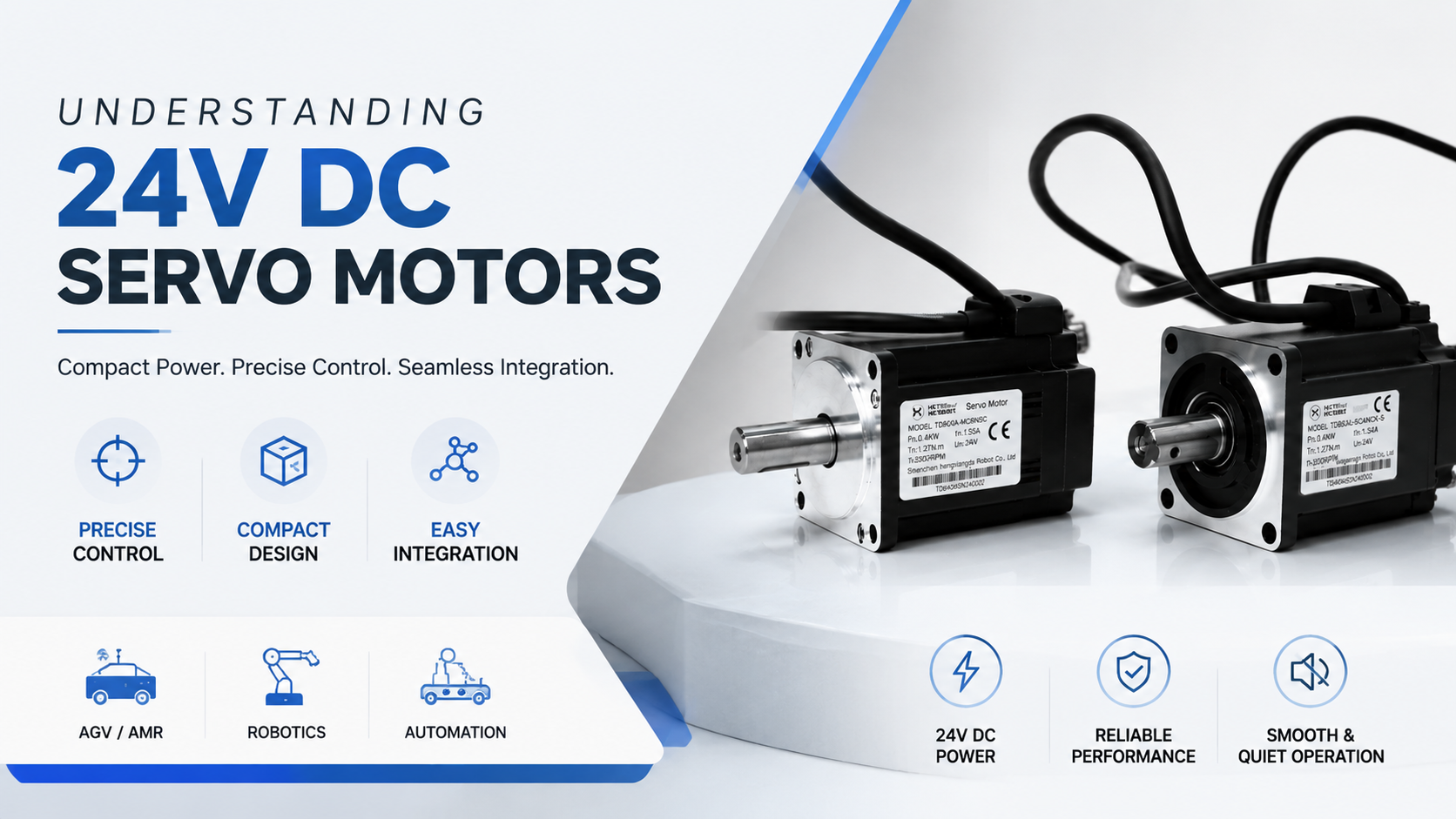
Low-voltage servo motors are becoming increasingly common in automation equipment, robotics and mobile platforms.
Among them, 24V DC servo motors are widely used because they provide a practical balance between performance, safety, system compatibility and installation flexibility.
Compared with traditional motors, servo motors offer more precise control of position, speed and torque. This makes them suitable for applications where accurate movement and stable operation are important.
From AGV/AMR systems to compact automation equipment, 24V DC servo motors provide a reliable motion solution for many industrial applications.

What Is A 24V DC Servo Motor?
A 24V DC servo motor is a servo drive system designed to operate with a 24V DC power supply.
Unlike a standard DC motor that mainly controls speed through voltage adjustment, a servo motor uses feedback control to achieve more accurate movement.
A typical servo motor system includes DC servo motor, encoder feedback, servo controller or integrated driver, and communication interface.
The encoder continuously monitors motor position and speed, allowing the controller to make adjustments and maintain accurate operation.
For compact automation systems, 24V servo motors are often selected because they can be easily integrated with existing low-voltage control systems.
Why Choose A 24V DC Servo Motor?
The popularity of 24V DC servo motors comes from several practical advantages.
Compact And Easy Integration
Many industrial systems already use 24V power supplies for sensors, controllers and other electrical components.
Using a 24V servo motor simplifies system design and reduces additional power conversion requirements.
This is especially useful for:
-
AGV and AMR platforms
-
Robotics
-
Automated equipment
-
Compact motion systems
Precise Motion Control
Servo motors provide closed-loop control through encoder feedback.
This allows better control of:
-
Position accuracy
-
Speed stability
-
Torque response
For applications requiring repeatable movement, servo motors provide better performance than conventional DC motors.
Flexible Communication Options
Modern 24V DC servo motors often support industrial communication protocols, making integration easier.
Common interfaces include:
-
CANopen
-
Modbus RTU through RS485
-
Pulse control
Different communication methods allow engineers to select the most suitable control architecture for their equipment.

24V DC Servo Motor Vs 48V DC Servo Motor
Both 24V and 48V servo motors are commonly used in industrial applications, but they are designed for different system requirements.
| Comparison | 24V DC Servo Motor | 48V DC Servo Motor |
| Power System | Suitable for low-voltage systems | Suitable for higher power systems |
| Current | Higher current at the same power output | Lower current requirement |
| Integration | Easier for battery-powered equipment | Better for higher-power applications |
| Application | AGV, AMR, compact automation | Larger mobile robots and higher-load systems |
| Safety | Lower voltage system design | Requires higher voltage management |
For many AGV and AMR applications, 24V servo motors provide a practical solution because they match common battery configurations.
However, when higher torque output, longer operating time or heavier loads are required, 48V systems may provide advantages.
The selection should be based on the complete system design rather than voltage alone.
Key Features To Consider When Selecting A 24V DC Servo Motor
Choosing a servo motor requires more than checking the voltage.
Torque And Speed Requirements
The motor needs to match the actual load conditions. Insufficient torque may affect acceleration and reliability, while excessive torque may increase unnecessary system cost.
Engineers usually evaluate:
-
Load weight
-
Required speed
-
Acceleration requirements
-
Operating cycle
Communication Interface
Modern automation systems require flexible communication between motors and controllers.
Common communication protocols include:
-
CANopen
-
Modbus RTU through RS485
-
Pulse control
The suitable interface depends on the control architecture of the complete system.
Brake Option
For some applications, a brake is an important safety feature.
A servo motor with brake can hold the position when power is removed, which is especially useful for vertical movement or systems where unexpected movement must be avoided.
How To Choose A Reliable 24V DC Servo Motor Supplier?
A reliable supplier should provide more than motor specifications.
Engineering support is important because servo motor selection often involves system-level considerations, including load calculation, mechanical integration and communication compatibility.
When evaluating suppliers, customers should consider:
-
Application experience
-
Customization capability
-
Communication support
-
Product reliability
-
Technical support
The right supplier can help reduce integration problems and improve the overall performance of the equipment.
HKT ROBOT 24V DC Servo Motor Solutions
Selecting a servo motor is not only about finding a product with the right voltage. The motor also needs to match the application, control system and mechanical requirements.
At HKT ROBOT, we focus on motion solutions for AGV and AMR with over a decade experience. Our 24V DC servo motors are available with different configurations, including models with brake and without brake, allowing customers to select the right solution based on their specific requirements.
The motors support common industrial communication protocols, including CANopen, Modbus and RS485, helping customers integrate them into different control systems.
With experience in AGV drive systems and mobile robot applications, HKT ROBOT understands that different projects require different combinations of torque, speed, installation space and control methods. Instead of only providing a motor, we help customers evaluate a suitable motion solution for the complete application.
Looking for a 24V DC servo motor solution? Send us your required voltage, torque, speed, load information and communication protocol. Our team is always ready to help recommend a practical motion solution for your project.
Share:
AGV Drive Wheel Selection Guide: How Load, Torque, Wear Resistance And Floor Conditions Affect Final Performance?
AGV Drive Wheel Vs Caster Wheel Vs Guide Wheel: Differences And Selection Guide