

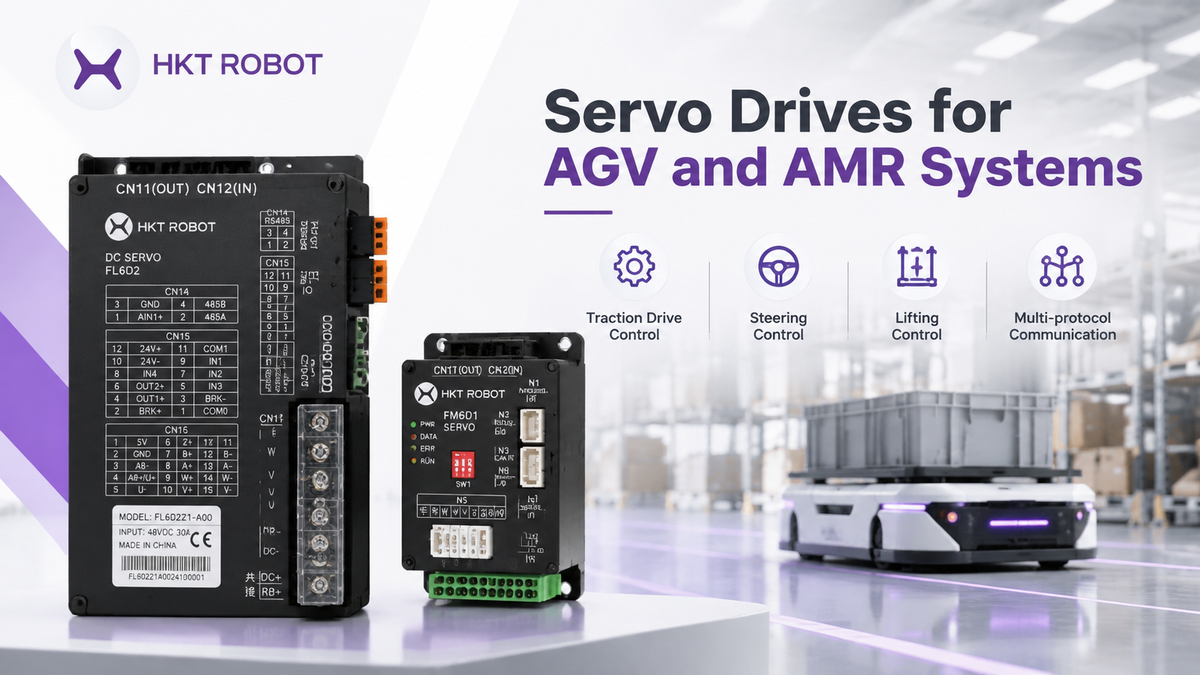
An AGV can carry a heavy load, turn through a narrow aisle, stop at a workstation, and move again hundreds of times a day. Behind these movements is a drive system that needs to respond to commands smoothly and reliably.
But here's the thing: not every AGV or AMR uses its servo drives in the same way. A warehouse robot with two drive wheels has different motion requirements from a forklift AGV with a steering system or a low-profile AMR with a lifting mechanism.
Choosing the right servo drive is only part of the job. Engineers also need to understand how the drive works within the complete motion system, how the motor and controller interact, and which configuration makes sense for the vehicle.
This guide looks at the role of servo drives in AGV and AMR systems, their main applications, and the differences between common drive configurations.

1. What Does a Servo Drive Do in an AGV or AMR?
A servo drive is the electronic unit that controls a servo motor's motion. It receives commands from the vehicle controller, regulates the electrical power supplied to the motor, and uses feedback to help the motor follow the requested speed, position, or torque.
Think of it as the link between the vehicle's motion commands and the motor's actual movement.
The vehicle controller determines how the AGV should move based on navigation, path planning, and other system inputs. The servo drive handles the motor-level control needed to carry out those commands.
For example, when an AMR approaches a workstation, the controller may request a gradual reduction in speed. The servo drive adjusts motor output to follow that command. Encoder feedback allows the drive to monitor actual motor movement and correct deviations within its control loop.
The drive can also monitor operating conditions and report faults to the vehicle controller, depending on its features.
This matters because AGVs rarely operate under one fixed load or motion profile. Payloads change, wheels encounter different floor conditions, and the vehicle repeatedly accelerates and decelerates. The drive needs to respond to these changing demands within its operating limits.
2. Where Are Servo Drives Used in AGV and AMR Systems?
Servo drives are commonly used in the main motion functions of mobile robots. Their role depends on the vehicle architecture and the mechanical components connected to each motor.
Traction and Differential Drive
In a differential-drive AGV, the left and right drive wheels are powered independently. The vehicle moves straight by coordinating their speeds and turns by changing the relative speed of each wheel.
Each traction motor needs an appropriate control channel. Servo drives help regulate wheel speed and torque as the vehicle accelerates, carries different loads, or follows a curved path.
For warehouse AMRs, this arrangement offers a relatively simple mechanical design. However, the two sides still need to work together. Differences in wheel diameter, traction, or motor response can affect the vehicle's movement.
Steering Drive Systems
A steering-drive module combines wheel propulsion with a steering mechanism. Depending on the design, it may contain separate traction and steering motors.
The traction motor controls wheel rotation, while the steering motor changes the wheel's angle. The controller coordinates these movements to achieve the requested vehicle direction.
This configuration is useful when an AGV needs to maneuver through narrow aisles, approach loads from different directions, or follow paths that are difficult to handle with differential drive alone.
For these systems, servo drive performance is only one part of the equation. Steering feedback, mechanical backlash, calibration, and coordination between the traction and steering axes also affect vehicle behavior.
Lifting and Load Handling
Some AMRs include a lifting platform that raises a shelf or transfers a load. Others use powered rollers, rotating platforms, or additional positioning mechanisms.
When these functions use servo motors, the corresponding drive channels become part of the motion-control system.
The traction system may move the vehicle to a workstation, while a separate axis controls the lifting operation. The controller must coordinate the two functions so that the vehicle and its payload move as intended.
The lifting mechanism also has different requirements from a traction wheel. Depending on its design, it may need position feedback, a holding brake, or additional measures to prevent an unsupported load from moving.
A drive configuration that works well for vehicle movement should not automatically be assumed suitable for every auxiliary axis.
3. Common Servo Drive Configurations for AGVs and AMRs
There is no single configuration that suits every mobile robot. The choice depends on the number of controlled axes, available chassis space, wiring requirements, and the way the vehicle will be maintained.
Three common approaches are worth considering.
Separate Servo Motor and Servo Drive
In a conventional arrangement, the servo motor and servo drive are separate components. The motor connects mechanically to the gearbox or drive wheel, while the drive is mounted elsewhere in the chassis.
This setup gives engineers flexibility when selecting motors and drives. It can also make individual components easier to access or replace.
The trade-off is wiring. Motor power cables, feedback cables, and drive connections need to be routed through the vehicle. In a compact AMR, finding enough room for the drives and keeping the wiring organized can take considerable effort.
Separate components are still a practical choice when the application benefits from flexible component selection and straightforward access to the drive electronics.
Integrated Servo Motor-Drive Solutions
An integrated servo motor-drive combines the motor and drive electronics into one assembly. Depending on the design, this can reduce external wiring and eliminate the need to mount a separate drive unit elsewhere in the chassis.
For low-profile AMRs, that can make packaging easier. It may also reduce the number of external connections that need to be installed and maintained.
However, integration is not automatically better in every situation. The complete assembly still needs adequate thermal management, suitable mounting space, and convenient access to its connectors.
Think of it as a packaging decision rather than a guarantee of better motion performance. Both integrated and separate systems can deliver suitable control performance when properly designed for the application.
Multi-Axis Servo Drive Systems
A multi-axis drive can control multiple motors through independent drive channels in one physical unit, provided the hardware supports the required configuration.
This can reduce the number of separate drive units and simplify installation. It may be useful when several compatible motor axes are installed in the same vehicle.
The important distinction is that multiple motors still need the control functionality required by the application. A standard single-axis drive should not be assumed capable of independently controlling two motors.
Before adopting a multi-axis arrangement, confirm the available channels, motor compatibility, feedback interfaces, and controller requirements.
4. How the Drive Configuration Changes With the Vehicle Design
The following examples show how different AGV architectures affect the motion system.
| AGV or AMR Application | Typical Motion Configuration | Main Consideration |
| Warehouse differential-drive AMR | Two independently controlled traction axes | Coordinated wheel speed and smooth acceleration |
| Two-module steering-drive AGV | Separate traction and steering axes for each module, depending on design | Steering-angle control and coordination |
| Low-profile lifting AMR | Traction axes plus one or more lifting axes | Coordination between travel and lifting |
| Forklift AGV | Traction, steering, and potentially lifting or mast-related axes | Load handling, braking, and motion coordination |
| Multi-directional mobile platform | Multiple independently controlled wheel or steering axes | Synchronization and control architecture |
hese are typical examples rather than fixed hardware specifications. Some modules integrate their drive electronics, and some systems use different motor-control technologies for auxiliary functions.
The key is to start with the actual mechanical architecture. Identify which movements require independent control, then determine how the corresponding drive channels will be implemented.
A vehicle with more wheels does not necessarily need more servo drives. Passive caster wheels, for example, do not normally require motor control.
5. What Matters Beyond the Servo Drive Itself?
A servo drive does not operate in isolation. Its performance depends on how well it works with the motor, mechanical transmission, controller, power supply, and the rest of the vehicle.
Several integration issues deserve attention.
Motor and gearbox compatibility
The motor provides torque and speed, while the gearbox changes the relationship between motor speed and output torque. If the mechanical transmission is unsuitable for the application, the drive may struggle to deliver the required vehicle movement even when its electrical specifications appear adequate.
Controller communication
The vehicle controller and servo drive need a compatible communication interface and control configuration. CANopen and EtherCAT are examples of interfaces used in motion-control systems, but the appropriate choice depends on the controller, required update rate, and application architecture.
Matching the protocol name alone is not enough. Device profiles, configuration parameters, and fault handling also need to be checked.
Power supply and braking
AGVs often use battery-powered DC systems. During deceleration, the motor may return energy to the DC bus. Depending on the system, this energy may be accepted by the battery or require another means of dissipation.
The drive, battery, and braking arrangement must therefore be compatible with the vehicle's operating conditions.
Thermal and installation conditions
A drive installed in a compact chassis may have less airflow than one tested on an open bench. Ambient temperature, mounting conditions, vibration, and duty cycle can all affect operation.
These factors should be considered at the system-design stage rather than left until the vehicle begins testing.
6. Common Problems When Integrating Servo Drives Into AGVs
Some motion problems are caused by the drive itself. Others come from mismatches between the drive and the wider system.
For example, an AGV that jerks during acceleration may have unsuitable motion settings, but the underlying cause could also involve mechanical backlash, excessive load, or poor coordination between axes.
A vehicle that loses positioning accuracy may have an encoder issue, yet wheel slip, wheel wear, and steering calibration can produce similar symptoms.
Communication faults require the same care. A drive that fails to respond consistently may have incorrect network settings, incompatible communication configuration, or a wiring problem.
The practical lesson is simple: do not replace a servo drive just because a motion problem appears at the motor. Check the complete system and identify the root cause before changing hardware.
For a new vehicle, it is also worth testing under representative conditions. No-load bench tests alone cannot confirm that the complete drive system will perform as expected with a full payload, repeated braking, and a realistic operating cycle.
7. HKT ROBOT: AGV and AMR Motion Control Solutions
Founded in 2013, HKT ROBOT focuses on motion-control technology and products for AGVs, AMRs, and industrial mobile robots. The company was established by engineers with extensive experience in electrical automation and has developed its own motion-control technology platform.
Our product range includes AGV servo motors, servo drives, integrated servo motor-drive solutions, steering drive wheels, differential drive units, planetary gearboxes, controllers, and lifting modules.
At HKT ROBOT, we understand that a servo drive is one part of a larger motion system. A differential-drive AMR, a steering-drive AGV, and a low-profile robot with a lifting mechanism have different mechanical and control requirements.
Our range of motion components allows engineering teams to evaluate the drive, motor, transmission, and wheel arrangement together, rather than treating each component as an isolated purchase.
Developing a new AGV or AMR, or looking for motion components for an existing platform? Share your vehicle architecture, motor specifications, and application requirements with HKT ROBOT. Our team can help you evaluate suitable servo drive and motion-system solutions for your project.
Explore our Servo Drive Solutions or contact our team to discuss your requirements.
FAQs for AGV Servo Drives
1. Can an AGV use servo drives from different manufacturers?
Yes, provided the motors, feedback devices, communication interfaces, and control requirements are compatible. However, mixing manufacturers can increase integration and troubleshooting work. Before combining components, confirm that the controller supports each drive and that the required control functions are available.
2. Can a servo drive be used for both traction and steering?
A servo drive can be used for either function if its specifications and control capabilities suit the motor and application. However, traction and steering motors often have different operating requirements. A system with separate traction and steering motors needs the appropriate independent control channels.
3. Do AGV servo drives need to support safety functions?
That depends on the vehicle's risk assessment and safety architecture. Ordinary motion-control functions do not automatically provide the safety functions required for emergency stopping or personnel protection. The complete vehicle must use appropriate safety-rated components and a validated safety design where required.
4. How should servo drives be tested before an AGV enters service?
Testing should reflect the intended operating conditions. This may include movement with representative payloads, acceleration and deceleration, turning, repeated stops, thermal behavior, communication faults, and recovery procedures. The exact test plan depends on the vehicle design and its safety requirements.
5. Is an integrated servo motor-drive always the best choice for a compact AMR?
Not necessarily. Integration can save installation space and reduce external wiring, but thermal management, maintenance access, available product ratings, and replacement strategy still matter. Compare the complete system requirements before deciding between integrated and separate components.
Share:
Best Wheel Material for AGV: PU vs Rubber vs Nylon