

When an AGV or AMR does not move smoothly, the first thing people often check is the control system. But in many real projects, the problem is not only in the software. The drive wheel may be the part that is holding the whole robot back.
A robot drive wheel is not just a wheel under the chassis. It is the point where motor torque, gearbox output, robot weight, floor friction, and motion control all meet. If the drive wheel is not selected properly, the robot may slip, accelerate slowly, stop inaccurately, wear out wheels too quickly, or overload the motor and gearbox.
For AGV and AMR manufacturers, choosing the right robot drive wheels is part of the complete motion system design. Load capacity matters, but it is only the starting point. Wheel diameter, tread material, torque margin, floor condition, turning method, duty cycle, and installation space all affect the final performance.

What Are Robot Drive Wheels?
Robot drive wheels are powered wheels that move a mobile robot. Unlike caster wheels, which only support weight and rotate freely, drive wheels are connected to a motor or drive system. They convert motor torque into traction and help the robot accelerate, brake, turn, and carry load.
In an AGV or AMR, robot drive wheels usually work together with caster wheels, support wheels, or steering modules to keep the robot stable during motion. Since drive wheels are the part that actually contacts the floor, their material, diameter, hardness, and grip have a direct impact on performance.
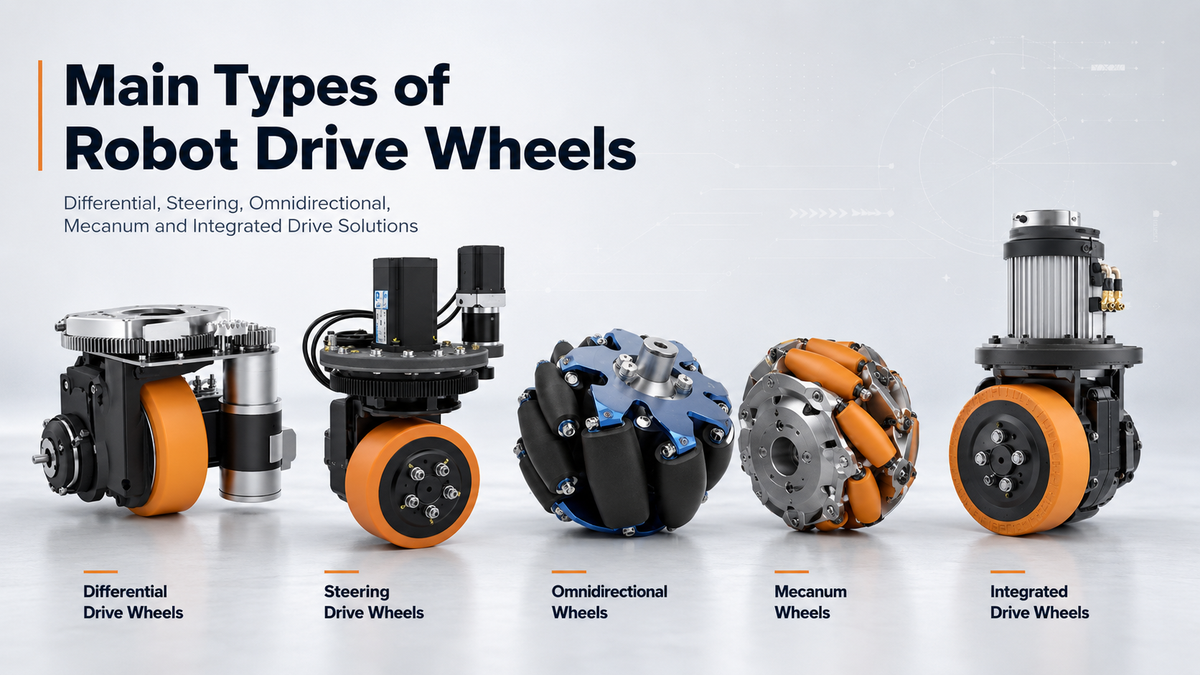
Main Types of Robot Drive Wheels
Different AGV and AMR platforms use different drive architectures. There is no single best option for every robot. The right choice depends on load, movement pattern, cost target, floor condition, and control complexity.
Differential Drive Wheels
Differential drive wheels are widely used in AMRs, cleaning robots, delivery robots, and compact warehouse robots. This structure usually uses two powered wheels on the left and right sides of the robot. By controlling the speed difference between the two wheels, the robot can move forward, turn, or rotate.
This design is simple, compact, and cost-effective. It is suitable for robots that need flexible movement in indoor environments.

Steering Drive Wheels
Steering drive wheels combine driving and steering functions in one module. They allow the robot to turn with a smaller radius and move more flexibly in narrow spaces.
This type is commonly used in forklift AGVs, tugger AGVs, heavy-duty AGVs, and mobile platforms that require accurate docking or high maneuverability. A steering drive wheel normally includes a drive motor, steering motor, gearbox, wheel, brake, and encoder.

Omnidirectional Wheels
Omnidirectional wheels use small rollers around the wheel circumference, allowing the robot to move in multiple directions without requiring a traditional turning movement. They are especially useful for compact AMRs and special platforms that need side movement or flexible positioning in limited space. However, omnidirectional wheel systems usually require more precise mechanical consistency and a more advanced control strategy, so they are not the best choice for every AGV or AMR application.
Mecanum Wheels
Mecanum wheels are a type of omnidirectional wheel designed to give the robot lateral movement as well as forward and backward motion. They are often used in mobile robot platforms with limited turning space. Mecanum wheels offer excellent maneuverability. Plus, they place higher demands on control, floor condition, and wheel consistency, so they are best suited for applications where flexibility matters more than maximum traction.
Integrated Drive Wheels
Integrated drive wheels combine several components into one compact unit, such as the motor, gearbox, wheel, brake, and encoder. This design reduces assembly work, saves installation space, and simplifies maintenance.
Integrated drive wheels are useful for robot manufacturers that want to shorten development time and improve system reliability.
How Robot Drive Wheels Work
The working process of a robot drive wheel is simple in concept but requires good matching between mechanical and electrical parts.
The controller sends commands, the motor driver controls the motor, the gearbox adjusts speed and torque, and the wheel turns that output into movement on the floor. For robots that need accurate positioning or safe stopping on ramps, encoders and brakes are often included as part of the drive module.
This is why robot drive wheels should not be considered as only “wheels.” In most AGV and AMR applications, they are part of a complete motion system.
How to Choose the Right Robot Drive Wheels
Robot drive wheel selection should start from the real working conditions, not from the rated specification. The right wheel depends on robot weight, payload, speed, floor condition, and duty cycle.
Match Load and Torque
Rated load is important, but real operation also includes dynamic load from acceleration, braking, turning, and slope climbing. The drive wheel, motor, and gearbox should be matched together, and enough torque margin should be kept for stable operation.
Choose the Right Wheel Size and Material
Wheel diameter affects ground clearance, torque demand, and obstacle-crossing ability. Wheel material also matters: polyurethane is common for indoor AGVs and AMRs, rubber offers better grip, and metal is usually used for heavy-duty or harsh environments.
Check the Real Floor Condition
The same drive wheel may perform very differently on smooth concrete, epoxy, wet floors, or uneven industrial surfaces. Before final selection, check floor roughness, slope, gaps, and whether the robot will run indoors or outdoors.
AGV vs AMR Drive Wheel Requirements
AGVs and AMRs share many components, but their drive wheel priorities are not always the same.
AGVs usually follow fixed or semi-fixed routes. Their drive wheel selection often focuses on stable load movement, predictable performance, long service life, and cost control.
AMRs operate in more dynamic environments. They may need to avoid people, shelves, pallets, and other moving objects. For AMRs, low slip, smooth turning, compact structure, and stable traction are often more important.
A simple way to think about it:
-
AGV: load stability and route reliability come first.
-
AMR: traction, flexibility, and motion consistency matter more.
-
Forklift AGV: torque, braking safety, and steering control are critical.
-
Cleaning robot: grip, corrosion resistance, and quiet operation matter.
-
Heavy-duty mobile robot: structure strength, thermal performance, and long-duty reliability are key.
Common Problems with Robot Drive Wheels
Some common problems are caused by poor selection or mismatched components.
Wheel slipping may happen when the wheel material does not match the floor condition or when the robot load distribution is poor. Fast wheel wear may be caused by incorrect hardness, excessive load, or rough floors. Weak starting force often means the motor torque or gearbox ratio is not suitable. Poor braking can occur when the brake is too small for the vehicle's weight. Motor overheating may be caused by overload, frequent start-stop cycles, or an unsuitable duty cycle.
These problems can often be reduced by selecting the correct wheel material, motor power, gearbox ratio, brake, and installation structure at the beginning of the project.
Conclusion
Robot drive wheels are small compared with the whole AGV or AMR. However, they have a major impact on motion performance. A poor selection can make a good robot feel unstable while a suitable selection can improve traction, reduce maintenance, and make the robot easier to control.
The best drive wheel is not always the largest or the most powerful one. It is the one that matches the robot weight, payload, speed, floor condition, torque requirement, duty cycle, and chassis design. Choosing the right robot drive wheels requires more than selecting a wheel diameter. Engineers need to consider payload, floor condition, speed, torque, motor matching, gearbox ratio, brake requirements, encoder feedback, installation space, and the robot’s overall working environment.
If you are looking for robot drive wheels for your AGV or AMR project, please contact us to find the most suitable solution. At HKT ROBOT, every drive wheel comes with a 2-year warranty, giving you peace of mind from start to finish.
Share:
A Complete Guide to AGV Components
AGV Differential Drive Unit: How It Works, Key Components, and Selection Guide