

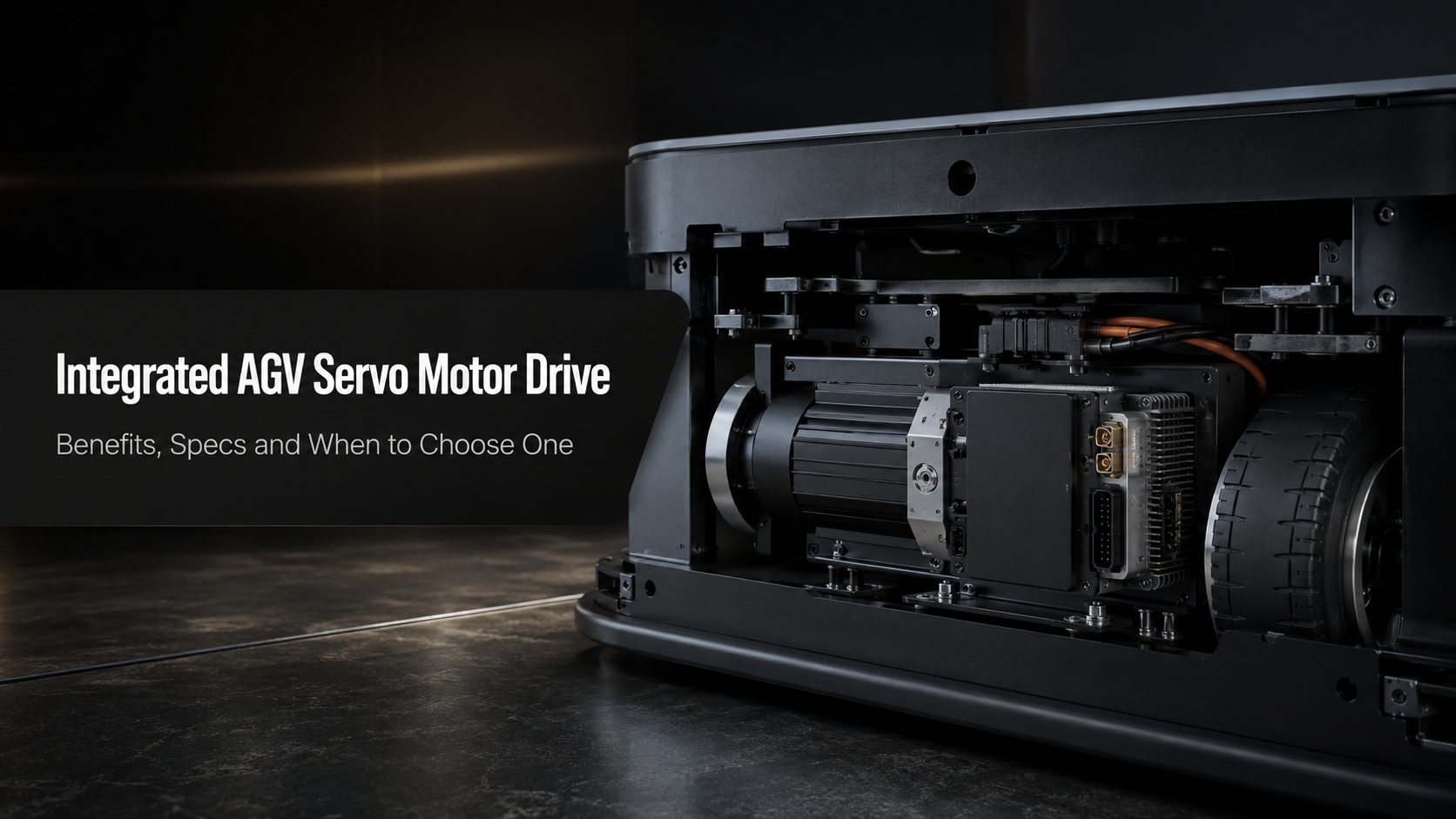
In a conventional AGV drivetrain, the servo motor and servo drive are separate components — the motor mounts to the wheel hub or gearbox, the drive mounts to the chassis frame, and a set of motor phase cables and encoder cables connects the two. This arrangement is flexible and familiar, but it introduces mechanical and electrical interfaces that take up chassis space, add wiring complexity, and create potential failure points that must be managed over the vehicle's operating life.
The integrated AGV servo motor drive eliminates that separation. In an integrated unit, the servo drive electronics are housed directly within or immediately adjacent to the motor body, reducing the system to a single mountable assembly with a single power input and a single communication connection to the vehicle controller. The motor phase currents never travel through separate cables — they are switched within the integrated drive and delivered directly to the motor windings without an external power stage.
This architecture is not universally superior to separate configurations, but for specific AGV and AMR application types it offers meaningful advantages in chassis integration efficiency, wiring reliability, and total system cost. Understanding where integrated motor drives perform best — and where their constraints become relevant — is the basis for making the right configuration choice at vehicle design time.

What Is an Integrated AGV Servo Motor Drive
An integrated servo motor drive — sometimes called a smart motor, motor-integrated drive, or all-in-one drive motor — is a unit that combines the servo motor, power electronics, and control electronics in a single mechanical assembly. The motor stator, rotor, and encoder are housed in the motor body as in a conventional servo motor. The servo drive's inverter stage, current sensing, and control processor are housed in an electronics section integrated into the same assembly — typically at the rear of the motor body or within an extended motor housing.
From a system perspective, the integrated unit presents the same functional interface as a separate motor-drive combination: it receives power from the battery bus, receives motion commands from the vehicle controller over a fieldbus, drives the load through its output shaft, and reports encoder position and drive status back to the controller. The integration is a packaging decision, not a functional architecture change. The closed-loop servo control, encoder feedback processing, and communication protocol handling are all performed within the integrated unit, just as they would be in a separate drive connected to a separate motor.
For AGV applications, 48V DC integrated servo motor drives covering power ranges from 100W to over 1,000W are available, covering the full range from compact light AMR drive axes to demanding traction and steering axes on medium-payload platforms.
Integrated vs Separate Motor and Drive: Key Differences
The choice between integrated and separate configurations is primarily a system integration trade-off, not a fundamental performance question. Both configurations can achieve equivalent motion control performance when properly specified. The differences that drive selection are mechanical, electrical, and practical.
Chassis space and packaging. An integrated unit occupies the same chassis volume as the motor alone — the drive electronics add length or diameter to the motor body but do not require a separate mounting location, DIN rail, or enclosure panel on the chassis. For compact AGV platforms where chassis real estate is constrained, this reduction in total component footprint can be decisive.
Wiring complexity. Separate configurations require motor phase cables (typically three conductors plus shield), encoder cables (four to eight conductors depending on encoder type), and separate power and communication connections to the drive. Each cable run is a potential failure point — connector fretting from vibration, cable fatigue from repeated flexing, and contamination ingress at connectors are among the most common field failure modes in AGV drivetrains. Integrated units eliminate the motor phase and encoder cable runs entirely, reducing total wiring complexity and the number of connectors in the drivetrain signal path.
Thermal management. In separate configurations, the drive's thermal load is managed at the drive mounting location — typically the chassis frame or a dedicated heat sink. In an integrated unit, the drive electronics and motor windings share the same thermal environment. This can be advantageous if the motor body provides an efficient heat dissipation path, or constraining if the motor's operating temperature is already elevated under high-load conditions. Thermal analysis for integrated units must account for the combined heat generation of motor copper losses and drive switching losses in the same assembly.
Serviceability. In separate configurations, a failed drive can be replaced without disturbing the motor installation, and vice versa. In an integrated unit, a drive electronics failure requires removing the complete motor-drive assembly from the vehicle for repair or replacement. For vehicles operating in high-utilization environments where minimizing downtime is critical, the serviceability implications of integrated configurations should be factored into the maintenance planning for the fleet.
Development flexibility. Separate configurations allow motor and drive to be sourced and specified independently, which provides more flexibility during vehicle development when motor requirements and drive performance parameters are still being refined. Integrated units are more constrained — the motor and drive characteristics are fixed together, and changing one requires changing both. For mature vehicle designs being manufactured at volume, this constraint is irrelevant. For platforms still in active development, separate configurations may be preferred until the motor specification is stable.

Key Specifications for Integrated AGV Servo Motor Drive Selection
Rated Power and Continuous Torque
The integrated unit's rated power and continuous output torque define its operating capability under sustained load. For AGV traction and steering axes, these values must cover the maximum continuous load at the target operating point — maximum speed at maximum payload on the steepest gradient the vehicle must traverse — with adequate margin for the duty cycle variations of real warehouse operation.
Integrated units, like separate drives, have both continuous and peak torque ratings. Peak torque covers starting, acceleration, and short-term overload events. The ratio between peak and continuous torque — typically 2:1 to 3:1 — determines the unit's ability to handle load transients without thermal limiting. Verify that the peak torque rating meets the vehicle's worst-case starting and acceleration torque demands.
Voltage and Input Power
48V DC input is the standard for AGV and AMR integrated motor drives targeting warehouse automation applications, consistent with the 48V battery bus standard discussed in the servo drive selection guide. Verify the unit's full operating voltage range — not just nominal voltage — covers the battery chemistry's full charge-discharge voltage swing. Regenerative braking capability, which feeds deceleration energy back to the battery bus, is a relevant specification for vehicles with high cycle rates where energy recovery affects total operational runtime.
Encoder Type and Resolution
The encoder integrated into the motor body determines position feedback resolution and the unit's suitability for applications requiring precise low-speed control or absolute position knowledge. Incremental encoders are standard and provide high resolution at lower cost. Absolute encoders — single-turn or multi-turn — eliminate the need for homing procedures after power cycling and provide position data immediately on startup, which is relevant for applications where the drive axis must know its position without a reference move. For steering axes on AGV platforms where wheel angle at startup is unknown, absolute encoder integration in the motor drive unit provides a meaningful operational advantage.
Communication Interface
The integrated unit communicates with the vehicle controller over the same interface types as separate drives — CAN bus, CANopen, EtherCAT, or RS485. Protocol compatibility with the vehicle controller is the primary selection constraint, as discussed in the AGV servo drive and AGV controller selection guides. Integrated units with multiple communication interface options provide more flexibility for integration into different vehicle controller platforms without hardware modification.
Protection Rating and Environmental Sealing
The integrated unit's IP rating covers both the motor body and the drive electronics section. Because drive electronics are more sensitive to moisture and contamination than motor windings, the IP rating of an integrated unit should be verified as applying to the complete assembly — including the drive electronics housing and all connector entries — rather than the motor body only. For AGV applications in environments with dust, cleaning operations, or elevated humidity, IP65 integrated units are strongly preferred over IP54 configurations.
Physical Form Factor and Mounting
The extended length of an integrated unit compared to a motor-only body requires chassis mounting provisions that accommodate the additional length without interference with adjacent components. The drive electronics section must be positioned to allow adequate thermal dissipation — either through direct chassis contact or through free air circulation — and must be accessible for connection of power and communication cables without requiring disassembly of adjacent structures. Verify that the unit's form factor fits the available chassis envelope before committing to a specific integrated unit model.
Where Integrated Motor Drives Perform Best in AGV Applications
Integrated AGV servo motor drives are particularly well-suited to application contexts where their packaging and wiring advantages are most valuable and their thermal and serviceability constraints are least impactful.
Compact latent AMR platforms. Latent AMRs operating under standard warehouse shelf bases have severe chassis height constraints that limit the size and number of components in the drive system. Integrated units eliminate separate drive enclosures and the routing of motor phase and encoder cables within already congested chassis interiors, enabling drivetrain designs that would be impractical with separate component configurations.
Multi-axis vehicles with numerous driven axes. Vehicles with four or more independently driven axes — some 4-way shuttle platforms and omnidirectional mobile bases — benefit significantly from integrated units. Each axis that uses an integrated unit eliminates a set of motor cables, reducing total wiring harness complexity and connector count by a factor that scales with axis count.
High-volume production programs with established motor specifications. For vehicles in stable production where the motor and drive specifications are fixed and validated, integrated units provide consistent bill-of-materials simplification and assembly labor reduction that compound across large production volumes.
Applications with regular vibration exposure. In AGV applications where vibration from floor surface transitions or handling operations creates repeated stress on cable connections, the elimination of motor phase and encoder cable runs reduces the primary failure mode associated with vibration-induced connector fatigue.

How Integrated Motor Drives Connect to the AGV System
From a system integration perspective, an integrated AGV servo motor drive connects to the vehicle in two ways: mechanically to the drivetrain, and electrically to the power bus and vehicle controller.
Mechanically, the output shaft connects to the gearbox, wheel hub, or drive module in the same way as a conventional servo motor. The motor body mounting flange and shaft interface dimensions must match the mating component, and the extended drive electronics section must clear adjacent chassis structures. Mounting provisions must address the combined weight of motor and drive electronics, which is greater than a motor-only unit of equivalent power.
Electrically, the integrated unit requires a DC power connection to the battery bus and a communication connection to the vehicle controller. The power connection must be sized for the unit's maximum input current, including peak current during acceleration. The communication connection carries the fieldbus signal for motion commands and status feedback. Compared to separate configurations, these are the only electrical connections required — there are no motor phase cables or encoder cables to route.
The vehicle controller communicates with the integrated unit using the same commands and protocols used with separate servo drives. From the controller's perspective, the integrated unit appears as a standard servo drive node on the fieldbus — the fact that the motor is integrated does not change the control interface or the motion command structure.
Common Selection Mistakes
Specifying an integrated unit based on motor ratings without verifying drive current capacity. The motor's rated current and the drive's continuous output current rating may differ in an integrated unit, particularly in configurations where the drive electronics are thermally limited below the motor's mechanical capability. Verify drive continuous current rating independently of motor power rating.
Assuming IP rating applies uniformly to motor and drive sections. Some integrated units are rated differently across their length — the motor section may meet IP65 while the drive electronics section achieves only IP54 due to connector design limitations. Confirm the IP rating specification applies to the complete unit including all connector entry points.
Selecting integrated units for axes where serviceability is critical. On vehicles where a single failed drive axis causes complete vehicle downtime and rapid replacement is essential for throughput, the increased disassembly required to replace an integrated unit compared to a panel-mounted separate drive is a real operational cost. For high-criticality axes on high-utilization vehicles, the serviceability advantage of separate configurations may outweigh the packaging benefits of integrated units.
Not accounting for the extended length in chassis layout. Integrated units are longer than motor-only bodies of equivalent power. Engineers who design the chassis mounting layout using motor-only dimensions and then switch to integrated units late in development frequently encounter interference problems that require chassis redesign.

What to Look for in an Integrated AGV Motor Drive Supplier
Matched motor-drive optimization. In a purpose-designed integrated unit, the motor winding characteristics, drive switching frequency, current control bandwidth, and encoder interface are optimized as a system rather than selected independently. Suppliers who design motor and drive as an integrated system — rather than assembling a standard motor with a third-party drive module — can achieve better efficiency, thermal performance, and control bandwidth than equivalent-specification separate components.
AGV-specific form factor and environmental specification. Integrated units designed for AGV applications differ from general industrial smart motors in their compact form factor, 48V input voltage range, sealed construction for warehouse environments, and communication interfaces matched to AGV vehicle controller platforms. Suppliers with AGV-specific integrated motor drive product lines provide more appropriate engineering baseline than general industrial automation suppliers offering mobile robot as a secondary market.
Documentation for system integration. Integration of an all-in-one unit requires clear documentation of the complete electrical interface — power input requirements, communication protocol details, encoder output specifications if externally accessible, thermal derating curves, and connector pinouts. Suppliers who treat this documentation as standard product deliverables reduce integration engineering effort significantly compared to those requiring custom engineering queries for each parameter.
FAQ
Is an integrated servo motor drive the same as a hub motor?
No. A hub motor integrates the motor directly into the wheel hub — the wheel rim is the motor rotor. An integrated servo motor drive integrates the servo drive electronics into the motor body, but the motor itself still connects to the wheel through a separate shaft and typically a gearbox. Hub motors eliminate the gearbox and external shaft but have different torque, speed, and cooling characteristics. Integrated servo motor drives retain the conventional motor-gearbox-wheel architecture while eliminating the separate drive enclosure.
Can an integrated motor drive replace a separate motor and drive in an existing AGV design?
In principle, yes — if the integrated unit's shaft interface, mounting flange, and power-torque characteristics match the existing installation, and if the chassis has space to accommodate the drive electronics section. In practice, the extended length of integrated units often requires chassis modifications. Replacing a separate configuration with an integrated unit is most practical during a planned redesign rather than as a direct swap in an existing vehicle.
What communication protocols are supported by 48V integrated AGV motor drives?
CAN bus and CANopen are the most common interfaces on 48V integrated motor drives for AGV applications. EtherCAT is available on higher-performance units. RS485 and Modbus are available on cost-optimized configurations. Protocol selection should match the vehicle controller's output interface to avoid the compatibility issues discussed in the AGV controller and servo drive selection guides.
How does thermal management work in an integrated unit compared to a separate drive?
In a separate configuration, the drive's thermal load is managed at the drive mounting location independently of the motor. In an integrated unit, both motor and drive heat must dissipate through the combined assembly. Well-designed integrated units route drive electronics heat through the motor housing to the mounting flange, using the gearbox or chassis structure as a heat sink. Under high continuous load conditions, the combined thermal load may require chassis-level thermal analysis that is not necessary when motor and drive are separately mounted with independent heat paths.
Are integrated motor drives more expensive than separate configurations?
At component purchase price, integrated units are typically comparable to or modestly more expensive than equivalent separate motor-drive combinations from the same supplier. Total system cost — including cabling, connectors, mounting hardware, and assembly labor — is frequently lower for integrated configurations due to the elimination of motor phase and encoder cable runs. For high-volume production programs, the assembly labor reduction is often the dominant cost factor that makes integrated configurations economically favorable.
Conclusion
The integrated AGV servo motor drive is not a universal replacement for separate motor and drive configurations — it is an architecture that offers genuine advantages in specific application contexts and real constraints in others. Compact chassis integration, reduced wiring complexity, and assembly labor efficiency are the primary drivers for choosing integrated units. Thermal management headroom, serviceability requirements, and development-stage flexibility are the primary reasons to maintain separate configurations.
For engineering teams making this decision at vehicle design time, the key is to evaluate chassis space, wiring harness complexity, production volume, and maintenance strategy simultaneously — rather than defaulting to one configuration without considering the trade-offs. Both approaches, when correctly specified and properly integrated, can deliver equivalent motion control performance in production AGV and AMR systems.
Share:
Four-Swerve-Wheel Omnidirectional AGV: Chassis Structure, Motion Features, And Applications
AGV Steering Wheels for Stage Automation: Smooth, Precise, and Low-Noise Moving Platforms