

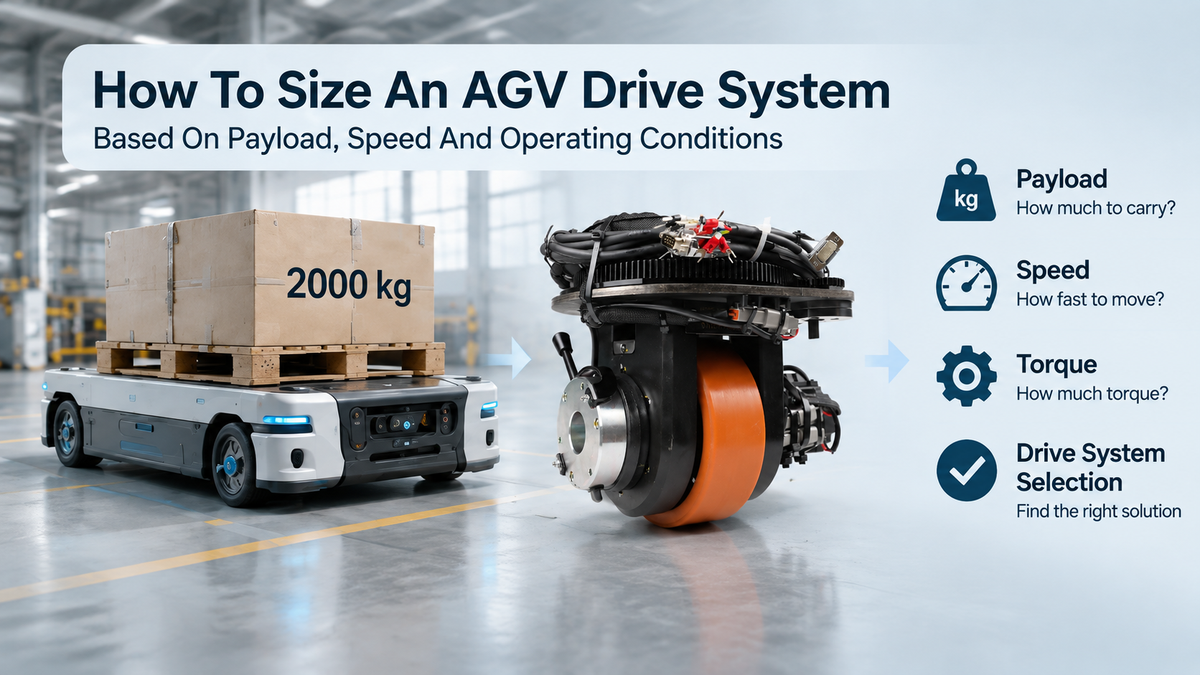
Choosing the right AGV drive system is not simply about selecting a motor with enough power.
The drive system needs to move the complete vehicle, including the chassis, battery, motors, controller, lifting mechanism, and payload. Traveling speed, wheel diameter, acceleration, floor condition, and drive configuration also directly affect the final selection.
A correctly sized drive system helps prevent common problems such as insufficient torque, wheel slipping, slow acceleration, overheating, and unstable positioning.
This guide explains how engineers can evaluate AGV drive requirements based on actual operating conditions.

What Determines AGV Drive System Size?
Payload is usually the first parameter people provide, but it is only the starting point.
For example, a 2-ton AGV does not necessarily require the same drive system as another 2-ton AGV. One may operate at low speed in a factory environment, while another may need fast movement, frequent acceleration, and precise positioning in a warehouse.
The main factors affecting AGV drive selection include:
| Factor | Why It Matters |
| Total vehicle weight | Determines the force required to move the AGV |
| Traveling speed | Affects motor speed and power requirements |
| Wheel diameter | Influences torque requirements and ground clearance |
| Acceleration | Determines peak torque demand |
| Number of driven wheels | Affects traction capability |
| Floor condition | Changes rolling resistance and wheel grip |
| Working environment | Influences duty cycle and system reliability |
The key point is simple:
The drive system should be selected based on the complete operating condition, not a single parameter.
Start With Total Moving Weight
One of the most common mistakes in AGV design is calculating only the payload.
The motor does not know whether the weight comes from the product being transported or the AGV itself. It only feels the total load that needs to be moved.
The basic calculation is:
Total Moving Weight = AGV Self Weight + Payload
For example:
An AGV has a self weight of 800 kg and carries a 2,000 kg payload.
The actual moving weight is:
800 kg + 2,000 kg = 2,800 kg
The drive system should be selected according to 2,800 kg, not 2,000 kg.
This simple difference is one of the reasons some AGVs experience poor acceleration or wheel slip after installation.
From Vehicle Weight To Required Traction Force
Once the total moving weight is confirmed, the next question is:
How much traction force does the AGV need?
The drive wheels must generate enough force to overcome rolling resistance and accelerate the vehicle. A simplified calculation can be expressed as:
F = m × g × μ
Where:
-
F represents traction force
-
m represents total vehicle mass
-
g represents gravitational acceleration
-
μ represents rolling resistance coefficient
For example, a 2,800 kg AGV running on a smooth factory floor with a rolling resistance coefficient of 0.03 would require approximately:
2,800 × 9.81 × 0.03 ≈ 824 N
This is only a theoretical value.
In real applications, engineers normally add a safety margin because the AGV may experience uneven floors, different load positions, frequent starts and stops, or turning resistance.
A drive system selected exactly at the minimum value may work in ideal conditions but struggle in daily operation.

Calculating Wheel Torque For AGV Drive Systems
After knowing the required traction force, the next step is converting this force into wheel torque.
The relationship is:
T = F × r
Where:
-
T = Wheel torque
-
F = Traction force
-
r = Wheel radius
Assume an AGV requires 1,000 N of traction force and uses 200 mm diameter drive wheels.
The wheel radius is:
0.1 m
The required wheel torque is:
1,000 × 0.1 = 100 Nm
If the AGV uses two driven wheels, each wheel needs approximately 50 Nm before considering additional safety margin.
This calculation shows why wheel diameter is important. A larger wheel can improve ground clearance and obstacle handling, but it also increases the torque requirement because the motor needs to generate force through a larger radius.
How Speed Affects AGV Drive System Selection
Payload determines how much weight the AGV needs to move. Speed determines how quickly the system needs to deliver that performance.
A low-speed heavy-load AGV usually prioritizes torque output and load capacity. A faster AMR may require a different balance between speed, efficiency, and control response.
This is where motor power and gearbox selection become important.
Motor torque determines whether the AGV can start moving and handle resistance. Motor power determines how quickly it can maintain movement.
The relationship is:
Power = Torque × Speed
This is why choosing an AGV motor only by wattage is usually not enough. The motor, gearbox, and wheel size need to work together as a complete system.
Why Gear Ratio Matters In AGV Drive Systems
The gearbox is what creates the balance between speed and torque.
A higher reduction ratio increases output torque, which is useful for heavy-load AGVs, slopes, or applications requiring strong starting force. However, it also reduces maximum traveling speed.
A lower reduction ratio allows faster movement but provides less torque.
There is no universal "best" gear ratio for AGV applications. The correct choice depends on the vehicle weight, wheel diameter, required speed, acceleration, and operating environment.
A Practical Example: 2 Ton AGV Drive System Calculation
Let's look at a simple example.
An AGV has:
-
Payload: 2,000 kg
-
Vehicle weight: 800 kg
-
Total moving weight: 2,800 kg
-
Drive wheel diameter: 200 mm
-
Two driven wheels
Based on the operating conditions, the required traction force is estimated at around 1,000 N.
The wheel torque calculation is:
1,000 N × 0.1 m = 100 Nm
With two drive wheels:
100 Nm ÷ 2 = 50 Nm per wheel
This gives the basic torque requirement.
However, the final drive system should include additional margin for acceleration, operating cycles, floor conditions, and unexpected loads.
The actual selection may require adjusting the motor, gearbox ratio, wheel size, or drive configuration.
Common Mistakes When Selecting An AGV Drive System
One common mistake is selecting a motor only based on payload.
Another is ignoring load distribution. In real AGV applications, the load is not always evenly distributed between wheels. Battery location, lifting mechanisms, and payload position can significantly affect traction.
Some projects also try to solve performance problems by simply increasing motor size.
However, a larger motor cannot fix an incorrect wheel design, unsuitable gear ratio, or insufficient contact pressure between the drive wheel and the floor.
AGV performance depends on the complete drive system working together.
How HKT ROBOT Supports AGV Drive System Selection
At HKT ROBOT, we provide complete AGV drive solutions, including drive wheels, differential drive units, steering drive units, motors, gearboxes, and controllers.
Instead of selecting individual components separately, we help customers evaluate the complete application, including vehicle weight, payload, speed, wheel configuration, installation space, and working environment.
The goal is not to use the largest motor or the biggest wheel.
The goal is to find the right combination that provides reliable movement, stable control, and long-term performance.
FAQs
1. How do I calculate the required AGV motor size?
AGV motor selection depends on total vehicle weight, required speed, wheel diameter, traction force, acceleration, and operating conditions.
2. Does AGV payload determine motor power?
No. Payload is only one part of the calculation. The AGV self weight and working environment also affect the required drive system.
3. What information should I provide when selecting an AGV drive system?
Important information includes payload, vehicle weight, speed, wheel diameter, drive configuration, floor condition, and working cycle.
4. Should I select the motor or drive wheel first?
Motor, gearbox, and wheel should be selected as one system because each parameter affects the others.
Share:
AGV Motor Selection Guide: How To Choose The Right Motor For Heavy Loads
Industrial Drive Wheel for AGV and AMR Robots: How to Choose the Right AGV Drive Wheel