

In intelligent logistics, warehouse automation, and industrial mobility systems, the chassis is the foundation of every mobile robot. It defines the robot's maneuverability, load capacity, movement precision, and suitability for different environments. Selecting the optimal AGV or AMR chassis structure is essential to achieving high operational efficiency, safety, and scalability.
Below is a comprehensive comparison of 10 mainstream chassis models, each explained with structural features, drive logic, typical applications, and integration recommendations.
1️⃣ Two-Wheel Differential Chassis
Structure: Two independently driven wheels positioned on both sides of the chassis, supported by one or more passive caster wheels.
Motion Capabilities: Forward, backward, in-place turning via speed differential.
Applications: Indoor navigation AGVs, small delivery bots, robotic education platforms.
Advantages: Cost-effective, easy to control, ideal for simple path-following robots.

2️⃣ Four-Wheel Differential Chassis
Structure: All four wheels powered by independent motors, offering stronger traction and greater load capacity.
Motion Capabilities: Smooth curve driving, enhanced terrain adaptability.
Applications: Outdoor logistics bots, heavy-duty transport AGVs, patrol robots.
Deployment Note: Suitable for rough or sloped environments.

3️⃣ Ackermann Steering Model
Structure: Front-wheel steering and rear-wheel drive, mimicking conventional automobile steering geometry.
Motion Capabilities: Stable cornering, tight turning radius, accurate trajectory tracking.
Applications: Autonomous outdoor vehicles, testbed driverless cars, smart park shuttles.
Deployment Note: Best paired with LIDAR SLAM, GPS-IMU navigation systems.

4️⃣ Mecanum Wheel Chassis
Structure: Each wheel includes passive rollers mounted at an angle (commonly 45°), enabling synthetic vector movement.
Motion Capabilities: Omnidirectional movement: forward, sideways, diagonal, in-place rotation.
Applications: Hospital delivery robots, pick-and-place bots, exhibition service robots.
Deployment Note: Performs best on smooth indoor surfaces with fine navigation control.

5️⃣ Four Omni-Wheel Chassis
Structure: Wheels with rollers set at 90° to the wheel plane, allowing high-precision decoupled motion.
Motion Capabilities: True omnidirectional movement with high positional accuracy.
Applications: Assembly line AGVs, automatic docking platforms, precision alignment tasks.
Use Case: Widely used in electronics factories and automated component feeders.

6️⃣ Three Omni-Wheel Chassis
Structure: Three omni wheels placed 120° apart on the same plane, enabling motion via vector synthesis.
Motion Capabilities: Full 360° motion, quick response, compact design.
Applications: Lightweight service robots, educational robots, interactive guides.
Deployment Tip: Ideal for speed-sensitive, low-load scenarios.

7️⃣ Four-Swerve Drive Chassis
Structure: Each wheel has an independent drive and steering motor, enabling complete direction control.
Motion Capabilities: Lateral shifting, point rotation, obstacle avoidance, agile maneuvering.
Applications: High-end shuttle AGVs, flexible transport platforms, dynamic factory logistics.
Case Study: Battery manufacturing line using heavy-load 4-swerve AGVs for real-time part delivery.

8️⃣ Dual Steering Wheel Chassis
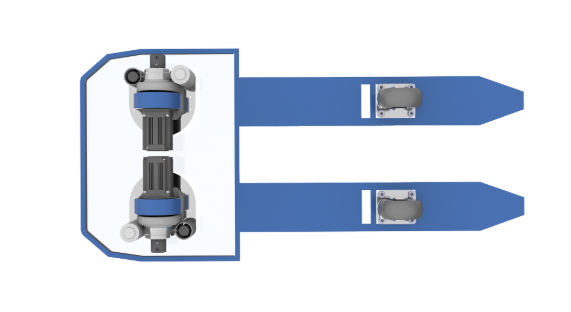
Structure: Two steerable drive wheels with one or more support wheels; both rotation and traction managed by the same units.
Motion Capabilities: High mobility with precise navigation, supports turning and lateral shift.
Applications: Medium-load warehouse AGVs, narrow-aisle sorting vehicles.
Deployment Tip: Works well with predefined route planning and moderate terrain.

9️⃣ Single Steering Wheel Chassis
Structure: One main wheel handles both steering and driving; usually paired with two passive support wheels.
Motion Capabilities: Simplified control logic, high traction, suitable for towing or dragging loads.
Applications: AGV forklifts, tugger vehicles, pallet transporters.
Deployment Note: Best used where steering synchronization is not critical.

🔟 Tracked Chassis
Structure: Uses continuous tracks for movement, available in steel or rubber variants depending on load needs.
Motion Capabilities: Superior obstacle handling, slope climbing, off-road stability.
Applications: Field inspection bots, geological survey robots, disaster response platforms.
Use Case: Deployed in power grid inspection in mountainous terrain and remote construction sites.

Share:
Precision Measurement of Rolling Resistance Coefficient for AGV Polyurethane Wheels
Drive Performance Study of Single Wheel AGV: Structure, Braking Stability, and Drive System Comparison