

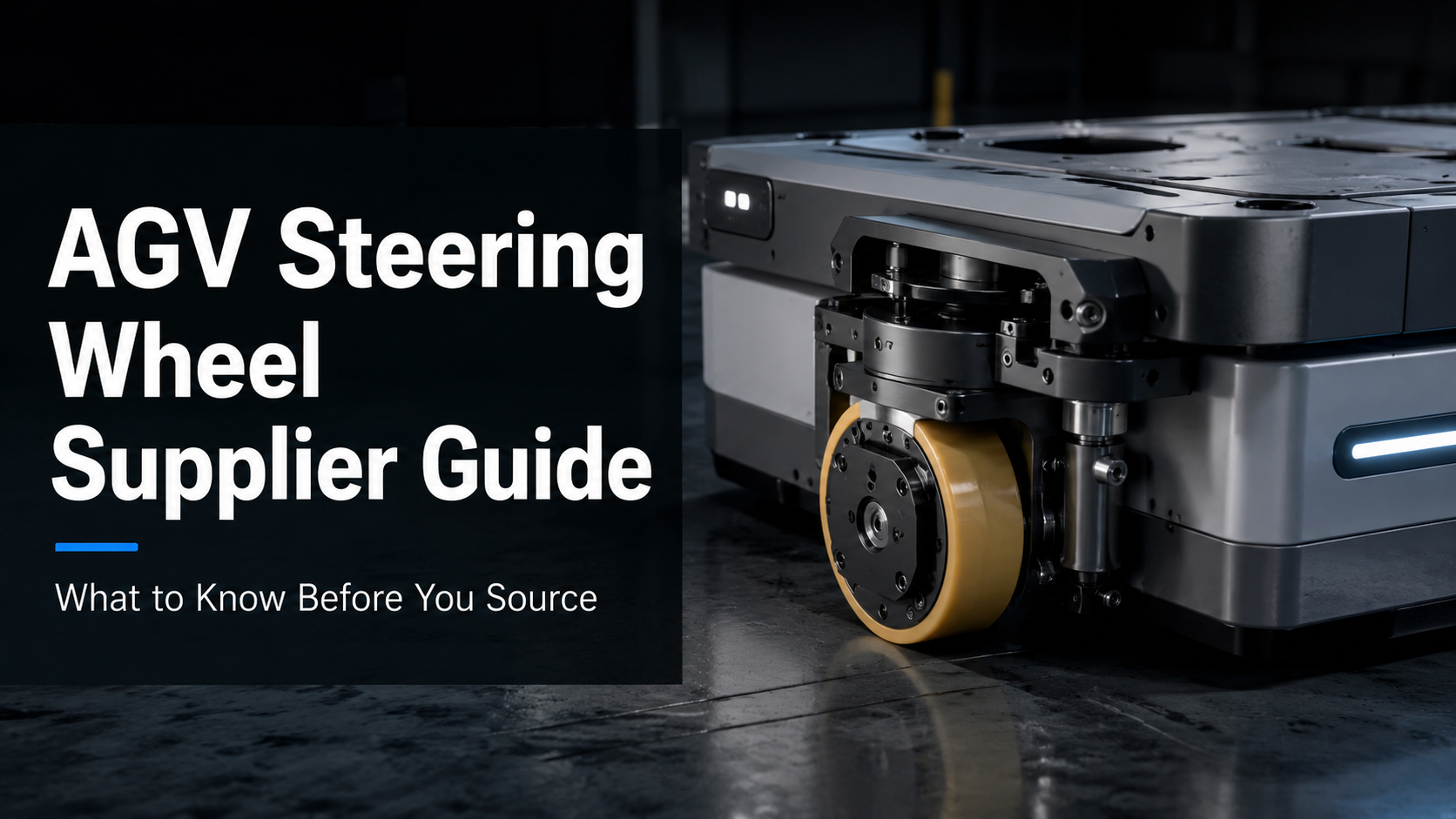
The steering drive wheel is the point where motor torque, structural load, and positional control all converge in a single rotating assembly. In an AGV or AMR, every navigation decision the software makes — turn angle, acceleration rate, cornering speed — ultimately depends on the mechanical response of the steering drive wheel to that command. A wheel module that introduces compliance, backlash, or inconsistent response degrades system performance in ways that no amount of software tuning can fully compensate.
For engineers and procurement teams building or scaling AGV fleets, the choice of AGV steering wheel supplier is one of the highest-leverage sourcing decisions in the project. Component specifications that appear equivalent on paper can differ substantially in practice, particularly over the high cycle counts of 24/7 warehouse operations.
This guide covers the main configurations of AGV steering drive wheels, the technical specifications that matter most for supplier evaluation, and the sourcing criteria that distinguish reliable long-term partners from catalogue distributors. Whether you are specifying components for a new AGV platform or qualifying an alternative supply source for an existing fleet, this is a practical reference for making that decision well.
What Is an AGV Steering Drive Wheel
An AGV steering drive wheel is a self-contained drive module that integrates a traction motor, gearbox, wheel hub, and steering actuator into a single mountable unit. Unlike a fixed-axis drive wheel — which can only drive in one direction — a steering drive wheel rotates around a vertical axis, allowing the vehicle to change direction without requiring a multi-wheel differential arrangement.
This architecture gives AGV designers significant flexibility. A single steering drive wheel combined with passive casters can form a complete, highly maneuverable drivetrain. Two steering drive wheels give full independent control of both drive and heading, enabling tight-radius turns and precise in-place rotation. Four steering drive wheels — as used in 4-way shuttle systems — provide full omnidirectional movement capability.
The steering mechanism itself may be driven by a dedicated steering motor through a gear or belt reduction, or integrated with the drive motor through a combined differential mechanism. The output in both cases is a wheel assembly that can simultaneously deliver traction force and rotate to any heading within its mechanical range.

Main AGV Steering Drive Wheel Configurations
Single-Axis Integrated Steering Wheel
The most common configuration in warehouse AMR and AGV applications. The drive motor and steering motor are housed in a compact vertical stack, with the drive motor delivering torque through a planetary gearbox to the wheel hub, and the steering motor rotating the entire assembly around a central vertical axis. This configuration offers a compact envelope, clean integration with vehicle chassis mounting flanges, and predictable kinematics for navigation software. It is the standard choice for latent AMRs, tote-handling AGVs, and compact transport robots.
Horizontal Steering Wheel
The integrated horizontal steering wheel places the drive motor axis horizontally within the wheel hub, eliminating the vertical motor stack and reducing the overall assembly height. This makes it particularly suited to low-profile AGVs operating under shelving systems with limited floor clearance, and to heavy-payload platforms where a wide, stable wheel base is required. Horizontal steering wheels are available in high-power configurations — 2,200W and above — with single-wheel load capacities exceeding 2,000 kg, making them the preferred choice for forklift AGVs and heavy industrial platforms.
Differential Drive Module
In differential drive configurations, two independently driven fixed-axis wheels produce steering by varying the relative speed of each wheel. This is not a steering drive wheel in the strict sense — there is no dedicated steering axis — but it is often considered alongside steering wheel modules when evaluating AGV drivetrain architectures. Differential drive is mechanically simpler and lower cost, but requires more floor space for turning and lacks the precise heading control of a dedicated steering axis, particularly during low-speed maneuvering.
Omni and Mecanum Wheel Modules
Mecanum and omni wheels use angled rollers around the wheel circumference to generate lateral force components, enabling holonomic movement — the ability to move in any direction without changing wheel heading. These configurations are used in applications requiring precise lateral positioning, such as automated assembly stations or narrow-aisle storage retrieval. They carry lower load ratings than conventional steering drive wheels and are more sensitive to floor surface conditions, which limits their use to controlled indoor environments.
Key Specifications When Evaluating AGV Steering Drive Wheel Suppliers
Rated Power and Load Capacity
Drive motor rated power and wheel load capacity are the primary sizing parameters. Common AGV steering drive wheel power ratings range from 400W for light AMRs to 2,200W or higher for heavy industrial platforms. Load capacity — the maximum downward force the wheel assembly can support continuously — must be matched to the vehicle's maximum payload plus chassis weight, distributed across the number of active drive wheels, with an appropriate service factor for dynamic loads during cornering and acceleration.
When comparing suppliers, verify that rated load figures reflect the bearing assembly at the output hub, not just the motor or gearbox ratings in isolation. These are different numbers and are not always consistently defined across supplier datasheets.
Steering Range and Steering Speed
Most AGV steering drive wheels offer continuous 360-degree steering rotation. Steering speed — the angular velocity at which the wheel can reorient — affects how quickly the vehicle can change heading and is a factor in overall system throughput, particularly in applications with frequent directional changes. Verify that the steering motor and reduction are sized for the required steering response at maximum load, not just at no-load conditions.
Gear Ratio
The drive gear ratio determines the relationship between motor speed and wheel output speed. For AGV applications, drive gear ratios between 20:1 and 50:1 are typical depending on wheel diameter, vehicle speed requirements, and load. The correct ratio should place motor operating points within the efficient mid-range of the motor's torque-speed curve under representative load conditions, not at peak torque. Suppliers offering a range of gear ratio options provide more flexibility for application-specific optimization.
Backlash and Positional Accuracy
Backlash in the drive gearbox and steering reduction affects both traction consistency and heading accuracy. For closed-loop position control systems — which are standard in modern AGV navigation — excessive backlash introduces error between commanded and actual wheel angle, degrading path tracking performance. Low-backlash gearbox specifications should be confirmed with test data from the supplier, not inferred from nominal gear quality grades.
IP Rating
AGV steering drive wheels operate close to the floor surface in environments that may include dust, moisture, cleaning agents, and debris. IP54 provides adequate protection for standard indoor logistics environments. Applications in food processing, cold chain, or outdoor yard operations require IP65 or above. Inadequate sealing leads to contamination of bearings and motor windings, which is one of the most common causes of premature wheel module failure in industrial deployments.
Mounting Interface and Chassis Compatibility
The steering drive wheel mounts to the vehicle chassis via a flange or bolt pattern. This interface must carry the full structural load of the vehicle and payload in all operating conditions. Non-standard or supplier-proprietary mounting interfaces add cost and complexity to chassis design and create dependency on a single source for replacement units. Preference should be given to suppliers offering standard mounting interfaces or willingness to match existing chassis geometry.

How to Evaluate an AGV Steering Wheel Supplier
Technical specifications tell part of the story. Supplier capability and reliability over the operational life of the fleet tell the rest. The following criteria distinguish suppliers that are viable long-term partners from those that are acceptable for a single order.
Product development history and AGV-specific experience. Steering drive wheels designed and tested specifically for AGV and AMR applications perform differently from general-purpose industrial drive modules adapted for the role. Suppliers with direct AGV application engineering experience understand the difference between catalogue specifications and real-world performance under the duty cycles, floor surface conditions, and control system requirements typical in warehouse automation.
Customization capability without excessive lead time. Standard catalogue modules rarely match every application requirement exactly. Gear ratio, mounting flange, motor power, and IP rating should all be adjustable within reasonable lead times for volume orders. A supplier that requires minimum order quantities of hundreds of units for any customization is not a practical partner for most AGV development programs.
Quality certifications and test documentation. ISO 9001 certification establishes that a documented quality management system governs production. CE marking confirms compliance with applicable EU machinery directives. Beyond certifications, the ability to provide actual test data — load testing, thermal testing, endurance cycle data — is a meaningful indicator of supplier confidence in product performance.
Warranty terms and after-sales technical support. A two-year warranty on drive components represents a reasonable standard for quality AGV steering drive wheel suppliers. Equally important is the responsiveness and technical depth of after-sales support. For AGV operators running continuous multi-shift operations, the cost of downtime caused by component failure and slow support response frequently exceeds the cost of the component itself.
Supply chain stability for volume programs. For AGV manufacturers scaling production, consistent component supply on predictable lead times is as operationally critical as component quality. Evaluate whether the supplier manufactures core components in-house or is a distributor assembling from third-party sub-suppliers, as this affects both quality control and supply resilience.
Common Sourcing Mistakes When Selecting an AGV Steering Wheel Supplier
Selecting on unit price without total cost of ownership. A lower-cost steering drive wheel that requires more frequent replacement, generates higher maintenance labor, or causes unplanned downtime events has a higher actual cost over the fleet operating life than a more expensive unit with longer service intervals and better reliability. Total cost of ownership — not unit price — is the relevant metric for drivetrain component sourcing decisions.
Not verifying load ratings independently. Supplier datasheets may express load capacity in ways that are technically accurate but not directly comparable across suppliers. Rated load at the wheel hub, maximum allowable radial force on the output bearing, and static structural load capacity are different quantities. Request clarification on how load ratings are defined and tested before comparing figures across suppliers.
Ignoring steering speed requirements under load. Many suppliers specify steering speed at no-load or light-load conditions. In actual AGV operation, steering occurs under full payload conditions. Verify that the steering motor and reduction can achieve the required angular velocity with full chassis and payload weight on the wheel.
Qualifying a single supplier without establishing an alternative. Single-source dependency for a critical drive component creates supply chain risk. For production AGV programs, qualifying at least two capable suppliers for the steering drive wheel — even if one is designated primary — provides operational resilience against supply disruptions.

FAQ
What load capacity should I specify for an AGV steering drive wheel?
Start with the maximum vehicle gross weight, including the chassis and maximum payload, then divide it by the number of active drive wheels.A service factor of 1.3 to 1.5 is recommended to account for dynamic loads during cornering, acceleration, and uneven floor conditions.For heavy-payload AGV platforms, horizontal steering wheel configurations are available with single-wheel load ratings exceeding 2,000 kg.
What is the difference between a steering drive wheel and a drive wheel unit?
A steering drive wheel integrates both traction drive and steering rotation in one module. It can drive the vehicle forward and backward while also changing direction through a steerable vertical axis. A drive wheel unit usually refers to a fixed-axis drive assembly without independent steering capability. This difference affects vehicle movement. Steering drive wheels allow tighter turning radii, more flexible navigation, and better maneuverability in narrow warehouse or production environments.
Can AGV steering drive wheels be sourced with custom gear ratios?
Yes. Professional AGV steering wheel suppliers usually support gear ratio customization within their standard product families. Common drive gear ratios for AGV applications are typically in the range of 20:1 to 50:1. Custom ratios outside this range may also be available, but they usually require longer lead times or volume orders. To choose the right ratio, provide the supplier with your required output speed, rated load, motor parameters, and wheel diameter. The supplier can then confirm the suitable gear ratio for your application.
What IP rating is required for an indoor warehouse AGV?
For general indoor warehouse applications, IP54 is usually the standard minimum requirement. If the AGV operates in areas with regular floor washing, high humidity, or liquid exposure, IP65 is a better choice. For cold chain logistics, food logistics, or other special environments, additional corrosion-resistant surface treatments may also be required beyond the basic IP rating.
Conclusion
The AGV steering drive wheel is among the most performance-critical components in a vehicle drivetrain, and the choice of AGV steering wheel supplier has direct consequences for fleet reliability, maintenance cost, and system throughput over the operational life of the deployment.
Evaluating suppliers on technical specification alone is insufficient. Load capacity verification methodology, customization capability, certification credentials, warranty terms, and supply chain stability all factor into whether a supplier is a viable long-term partner for a production AGV program.
The time invested in thorough supplier evaluation before component qualification — including sample testing, documentation review, and reference checking — consistently returns more value than the equivalent time spent on post-deployment troubleshooting of premature component failures.
Share:
AGV Lifting Mechanism: How It Works and How to Choose One
AGV Servo Drive Selection Guide: Key Specifications and What to Look For