

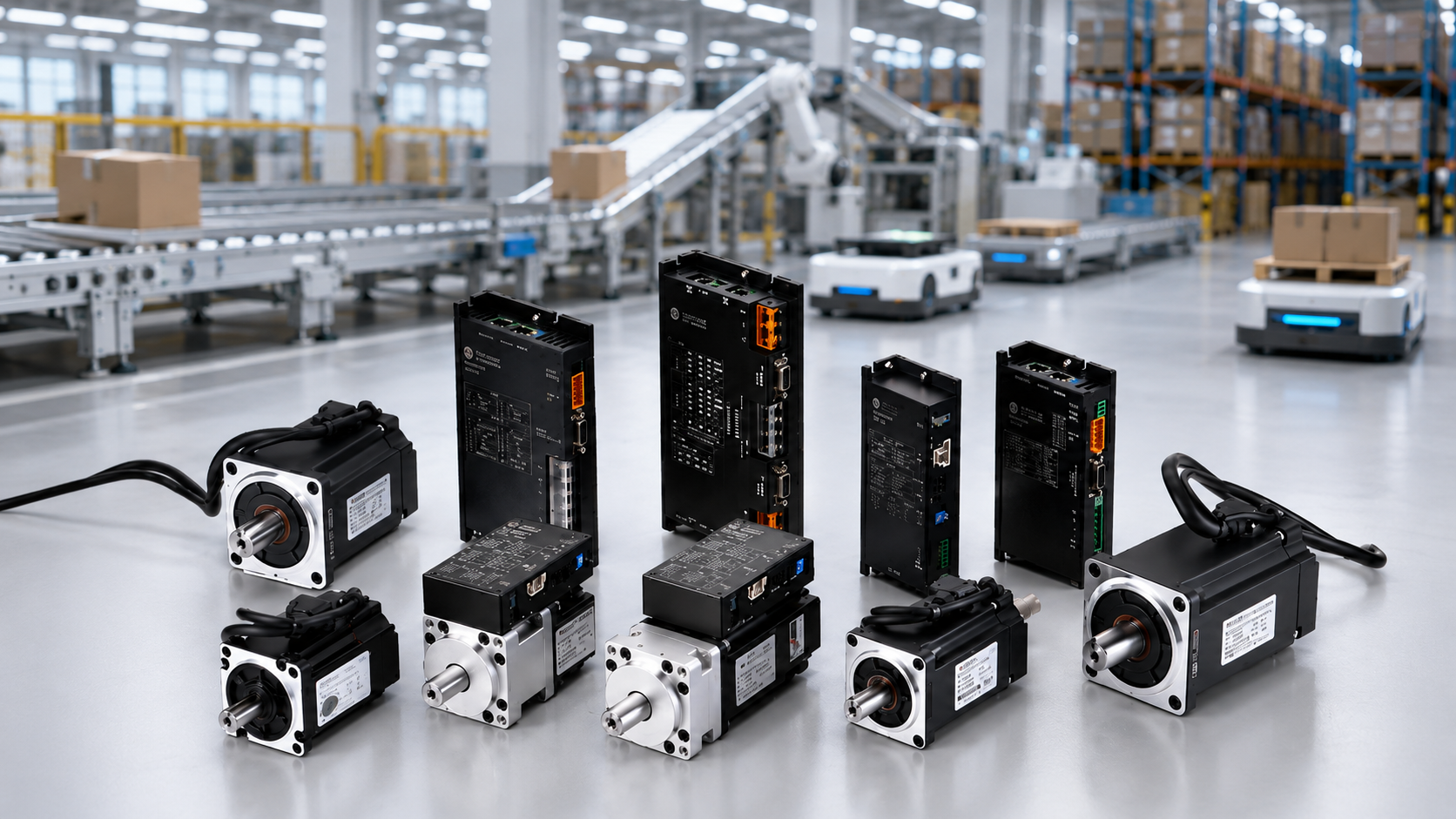
In AGV and AMR systems, vehicle stability and motion accuracy are often determined by the core drive components underneath the platform. Among these agv components, the servo motor plays a key role.
For automated guided vehicles, mobile robots, and warehouse handling robots, the motor is not only responsible for making the vehicle move. It also needs to keep the vehicle running smoothly at the required speed, direction, and path. That is why an AGV servo motor is commonly used in AGV and AMR systems where speed control, position feedback, and torque output are important.

What Is an AGV Servo Motor?
The main feature of an agv servo motor is closed-loop control.
In simple terms, a standard motor mainly rotates according to the input signal, while a servo motor uses an encoder to continuously feed back its actual position, speed, or angle. The system compares the target value with the actual value. If there is any difference, the servo drive adjusts the motor output automatically.

A typical AGV servo system usually includes:
Servo motor
Servo drive
Encoder
Gearbox or wheel module
Controller
The encoder works like the “eyes” of the motor. It tells the system the motor’s current position and speed in real time. With this feedback, the servo system can deliver more stable and accurate motion control.
In an AGV system, the servo motor does not work alone. It needs to match with other agv components, such as the servo drive, gearbox, wheel module, controller, battery system, and safety modules. Only when these parts work well together can the vehicle move reliably and smoothly.
Why AGV Servo Motors Are Important in AGVs and AMRs
AGVs and AMRs often operate in more complex conditions than fixed automation equipment. They may run for long periods in warehouses, factories, production lines, or semi-open working areas, and they often need to handle conditions such as:
- Frequent starts and stops
- Switching between empty-load and full-load operation
- Low-speed docking with shelves or workstations
- Straight-line travel, turning, and in-place rotation
- Parking on slopes or handling slight inclines
- Floor gaps, joints, or slightly uneven surfaces
- Long continuous operation
If the drive system responds slowly, the vehicle may have low-speed vibration, inaccurate stopping, steering angle errors, or unstable path tracking. For AMRs, these issues can also affect how well the navigation system performs in real operation.
The value of an agv servo motor is that it can use encoder feedback to continuously correct motion errors. This helps the vehicle stay closer to the target speed, target angle, and target position sent by the controller. That is one reason why high-performance AGVs and AMRs increasingly use servo drive systems.
Servo Motor vs Stepper Motor in AGV Applications
In general, stepper motors can be used in simple and low-cost mechanisms, while servo motors are a better choice for AGV and AMR applications that require accurate motion control, stable operation, and reliable feedback.
| Comparison Item | Servo Motor | Stepper Motor |
| Control Method | Closed-loop control with encoder feedback | Usually open-loop control |
| Feedback | Can detect actual position, speed, and movement status | Usually does not provide real-time feedback |
| Accuracy | Higher accuracy and better motion correction | Suitable for basic positioning, but accuracy may be affected by load changes |
| Load Handling | Better for heavy-load AGVs and AMRs | More suitable for light-load mechanisms |
| Motion Stability | More stable during acceleration, deceleration, turning, and stopping | May lose steps under sudden load changes or high acceleration |
| Cost | Higher cost, but better performance and reliability | Lower cost and simpler control |
| Best Used For | Accurate stopping, stable turning, heavy-load handling, and long-term continuous operation | Low-speed, light-load, and less demanding applications |
| Suitability for AGV/AMR | More suitable for AGV and AMR drive systems that require reliable feedback and stable motion | Suitable only for simple auxiliary mechanisms with lower accuracy requirements |
Key Parameters for AGV Servo Motor Selection
Choosing a suitable AGV servo motor is not only about motor power. The right motor should be selected based on the vehicle structure and actual motion requirements.
1. Load Capacity
The total weight of the AGV or AMR should be confirmed first, including the vehicle weight and maximum payload. The heavier the load, the higher the output torque required from the motor.
2. Speed Requirement
The target speed affects the motor speed and gearbox ratio. For high-speed operation, rated speed, maximum speed, acceleration, and deceleration performance all need to be considered.
3. Torque Requirement
AGVs often need higher instant torque during startup, climbing, emergency stops, and turning. For this reason, both rated torque and peak torque should be checked during selection.
4. Power Supply
Fixed equipment often uses 220V or 380V power, while mobile robots usually rely on battery power. Therefore, AGVs and AMRs more commonly use low-voltage DC servo solutions, such as 24V, 48V, or higher voltage platforms.
5. Brake Option
If the vehicle needs to park on a slope, lift loads vertically, or hold position after power-off, a servo motor with brake should be considered.
6. Communication Protocol
The AGV control system needs stable communication with the servo drive. Common control methods include CANopen, EtherCAT, RS485, and pulse control. Before selection, it is important to confirm whether the servo drive can match the vehicle controller or PLC system.
7. Installation Space
AGV chassis space is usually limited, so motor size, flange dimensions, shaft diameter, cable direction, and gearbox structure should be confirmed in advance.
Where AGV Servo Motors Are Used
In AGVs and AMRs, servo motors can be used in several key positions, including:
- Drive wheel module
- Steering wheel module
- Differential drive unit
- Lifting mechanism
- Conveyor transfer system
- Robot joint or auxiliary actuator
Different positions have different motor requirements. Drive wheel modules focus more on torque, speed, and running stability. Steering modules require accurate angle control and fast response. Lifting mechanisms need holding torque and safe braking.
Therefore, selecting an AGV servo motor is not just about choosing one motor model. It requires matching the motor with the vehicle weight, movement method, control system, and mechanical structure.
HKT ROBOT Servo Motor Solutions for AGV and AMR Systems
Founded in 2013, HKT ROBOT focuses on drive components for AGVs, AMRs, and industrial mobile robots. Our servo motor solutions cover compact low-voltage integrated units, 48V servo motor options, and high-power DC servo motors for mobile robots, warehousing and logistics equipment, forklift AGVs, and heavy-duty mobile platforms.
For different AGV projects, we can help customers match a suitable AGV servo motor and complete drive solution based on the load, speed, wheel diameter, power supply voltage, communication protocol, slope requirement, installation space, and working environment.
If you are developing an AGV or AMR system and need support with servo motor selection, drive wheel modules, steering wheel modules, or other agv components, please feel free to contact us. Our team will help you evaluate a suitable drive solution for your project.
Share:
AGV Caster Wheels Technical Guide for AGV/AMR Systems
Brushless Servo Motor for AGV: Key Specs and Selection Guide