

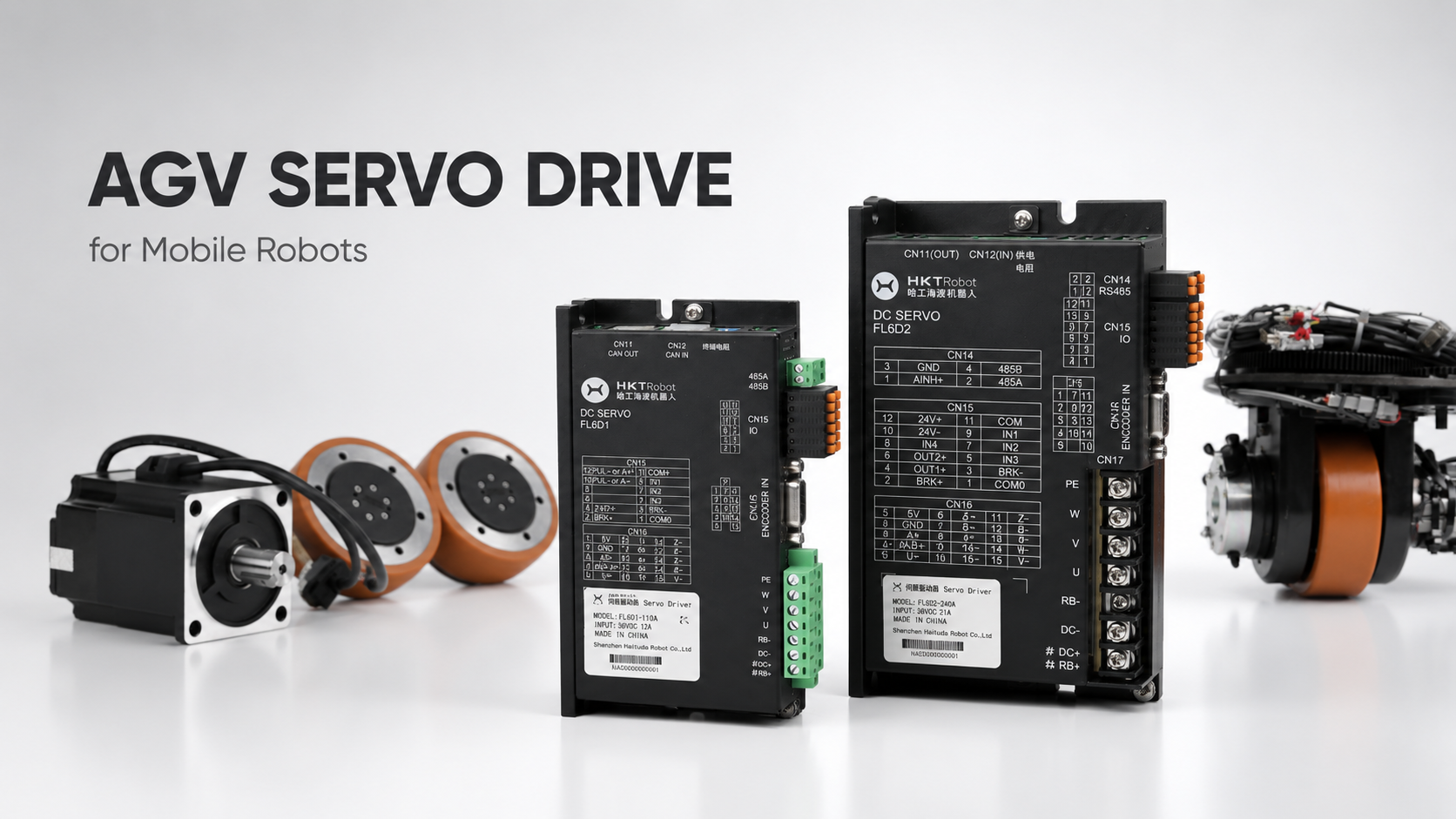
In AGV and AMR systems, the servo drive is not always the most visible component. Many people first notice the drive wheel, steering module, frame structure, battery, sensors, or navigation system. However, the servo drive has a direct influence on how the robot starts, stops, accelerates, brakes, turns, and responds under real working conditions.
A suitable AGV servo drive does more than make the motor rotate. It must work together with the servo motor, controller, drive wheel, steering module, load condition, floor environment, and control logic. When these parts are not properly matched, the final robot may still face unstable movement, long commissioning time, poor braking response, or inconsistent performance, even if every single component looks acceptable on paper.
At HKT-ROBOT, we often look at AGV and AMR motion problems from a system perspective. A servo drive should not be selected as an isolated electrical component. It should be evaluated as part of the complete mobile robot drive system, including the 48V servo motor, servo drive, controller, drive wheel, steering wheel assembly, and lifting or rotating module when required.
This article explains several common AGV servo drive problems and how to avoid them during product selection, testing, and system integration.
Why Servo Drives Matter in AGV and AMR Systems
The servo drive receives motion commands from the AGV controller and controls the servo motor according to the required speed, torque, and response. In a real AGV or AMR application, this process is not as simple as starting and stopping a motor.
The robot may need to move slowly near racks, turn in narrow aisles, stop accurately at a workstation, carry different loads, or operate continuously for long hours.
That is why the servo drive affects more than motor output. It influences low-speed stability, acceleration and braking behavior, torque response, positioning consistency, motor protection, and the communication between the controller and the drive system.
For mobile robot manufacturers, this means servo drive selection should not be based only on rated power or voltage. The actual working condition is more important. Load capacity, wheel diameter, reducer ratio, floor condition, speed range, braking requirements, communication method, and duty cycle all need to be considered before the drive system is finalized.
A drive may perform well in a simple bench test, but the real test happens after it is installed on an AGV or AMR platform. This is where system matching becomes critical.

Problem 1: Unstable Movement at Low Speed
Low-speed instability is one of the most common problems in AGV and AMR applications. The robot may shake slightly, move unevenly, vibrate during docking, or respond too suddenly to small speed commands.
In warehouse automation and factory logistics, these problems are not small details. They can affect docking accuracy, load transfer, positioning, and the overall impression of machine quality.
This problem often appears when the AGV moves near shelves, conveyors, pallets, or workstations. These are exactly the moments when smooth motion matters most. A robot that moves well at normal speed may still perform poorly when it needs to move slowly and precisely.
The cause is not always the drive wheel or mechanical structure. In many cases, low-speed instability is related to servo drive parameter tuning, motor and drive matching, load inertia, reducer ratio, or controller response. If the servo drive is selected only by rated power, without considering the real low-speed operating range, the final motion may not be smooth enough.
To avoid this problem, AGV manufacturers should evaluate the motor, servo drive, wheel diameter, load, and control response together. Low-speed testing should also be done under real or near-real working conditions, not only in no-load testing. A system that runs smoothly without load may behave very differently when carrying a full load or operating on an uneven floor.
For HKT-ROBOT, this is one reason why we do not look at the servo drive separately from the rest of the motion system. The 48V servo motor, servo drive, controller, drive wheel, and steering module need to work together. Good low-speed performance usually comes from proper matching, not from one component alone.
Problem 2: Poor Acceleration and Braking Response
Another common problem is poor acceleration or braking response. In real AGV and AMR projects, this may appear as sudden starting, delayed braking, unstable stopping distance, position overshoot, or inconsistent motion during frequent start-stop operation.
This issue can directly affect safety and operating efficiency. For example, an AGV carrying a heavy load must stop smoothly and predictably. If the braking response is delayed or unstable, it may affect docking accuracy or create unnecessary risk in a busy warehouse or production line.
Poor acceleration and braking response can come from several causes. The servo drive may not have enough capacity margin. The motor torque may not be sufficient for the load. The acceleration and deceleration curves may not match the actual working condition. In some cases, the system was selected based on theoretical data, but the real application includes frequent stops, load changes, slope sections, floor friction differences, or emergency braking requirements.
A reliable AGV servo drive solution should leave enough torque margin and consider the real duty cycle of the robot. It is not enough to confirm that the motor can move the vehicle. The system must also handle acceleration, deceleration, braking, and repeated operation over time.
This is especially important for AGV drive wheels and steering wheel assemblies. The drive system is responsible not only for moving the robot forward, but also for maintaining stable traction and controlled motion during speed changes. When the servo motor, servo drive, controller, and wheel module are properly matched, the robot is more likely to achieve smooth acceleration and stable braking in actual operation.
Problem 3: Servo Drive and Motor Mismatch
A servo drive may look suitable from its rated power, but it still needs to match the servo motor correctly. Voltage, rated current, peak current, encoder type, control mode, feedback method, and communication requirements all matter.
When the motor and servo drive are not properly matched, the AGV may experience weak torque output, motor heating, alarm messages, slow response, difficult tuning, or unstable motion. Sometimes the problem does not appear immediately during initial testing. It becomes more obvious after the robot starts running with load, turning frequently, or operating for long periods.
This mismatch is more likely to happen when the motor, servo drive, controller, and mechanical module come from different suppliers without enough integration testing. Each component may be technically acceptable, but the final system may require a long time to debug. In batch production, this can become even more difficult because small differences between components may lead to inconsistent performance between robots.
For AGV and AMR manufacturers, choosing a matched servo motor and servo drive solution can reduce integration risk. It also makes communication, parameter setting, troubleshooting, and future maintenance easier.
HKT-ROBOT provides AGV/AMR motion components such as 48V servo motors, servo drives, AGV controllers, drive wheels, steering wheel assemblies, and lifting and rotating modules. In practical applications, these products are often not considered separately. The better approach is to match them according to the robot’s load, speed, installation space, control method, and working environment.
A matched system does not only help the robot move. It helps the whole AGV platform become easier to test, easier to adjust, and easier to support after delivery.
Problem 4: Difficult Parameter Tuning and Long Commissioning Time
In many AGV projects, the servo drive itself is not defective. The real challenge is parameter tuning. The robot may work well without load but become unstable under full load. It may move smoothly in a straight line but perform poorly during turning, docking, or frequent start-stop operation.
This type of problem often comes from incomplete application information before selection. If the supplier does not know the actual load, speed range, wheel diameter, reducer ratio, floor condition, working cycle, communication method, and braking requirements, it is difficult to recommend the right drive solution. The result is that the robot manufacturer has to spend more time adjusting parameters after assembly.
Long commissioning time is not only a technical issue. It also increases project cost. For overseas AGV and AMR projects, long debugging cycles can delay delivery, increase support pressure, and make after-sales service more complicated.
To reduce this risk, servo drive selection should start with the real application, not just the product datasheet. Before choosing the drive system, it is helpful to define how the robot will move, what load it will carry, how often it will start and stop, what speed range it needs, and what type of control system will be used.
A good AGV servo drive solution should provide more than hardware. It should support parameter matching, application testing, and system-level integration. For HKT-ROBOT, this is an important part of supporting AGV and AMR customers. The goal is not only to supply a servo drive, but to help the drive system work reliably with the motor, controller, wheel module, and actual robot platform.

How to Avoid These AGV Servo Drive Problems
To avoid AGV servo drive problems, manufacturers should evaluate the complete drive system before selecting a single component. The servo drive needs to be matched with the servo motor, controller, drive wheel, steering module, load condition, speed range, and working environment.
Before final selection, the most important information includes the robot load, wheel diameter, voltage level, motor power, communication method, braking requirements, working cycle, installation space, and floor condition. These details help determine whether the servo drive can deliver stable performance in real operation.
It is also important to test the system under realistic conditions. No-load testing is useful, but it is not enough. Full-load movement, low-speed operation, turning, docking, braking, and long-term running should all be checked before batch deployment.
For AGV and AMR manufacturers, another important point is consistency. A sample that works well is only the first step. In real projects, the whole batch needs to maintain stable motion performance. This requires consistent components, standardized parameters, proper testing, and reliable technical support.
When the servo motor, servo drive, controller, and mechanical drive module are selected as a matched system, many problems can be reduced before they happen. This can shorten commissioning time, improve motion stability, and make future maintenance easier.
Summary
A reliable AGV servo drive solution is not only about power output. It should support smooth low-speed movement, stable acceleration and braking, proper motor matching, easier tuning, and reliable long-term operation.
In real AGV and AMR applications, many motion problems come from system mismatch rather than one single component. The servo drive, servo motor, controller, drive wheel, steering module, load, and working environment must be considered together.
For mobile robot manufacturers, choosing a matched drive system can help reduce debugging time, improve movement stability, and support more reliable project delivery.
HKT-ROBOT focuses on AGV and AMR motion components, including drive wheels, steering wheel assemblies, 48V servo motors, servo drives, controllers, and lifting and rotating modules. By looking at these parts as one complete drive system, AGV and AMR projects can achieve better performance in real working conditions.
If you are developing or upgrading an AGV/AMR platform, HKT-ROBOT can support servo motor, servo drive, controller, drive wheel, and steering module matching based on your load, speed, installation space, and application requirements.
Share:
How to Choose the Right AGV Wheels? A Deep Dive into AGV Drive Wheels, AGV Steering Drive Wheels, and Casters
Why the Planetary Gearbox Is the Backbone of Every AGV Drivetrain