

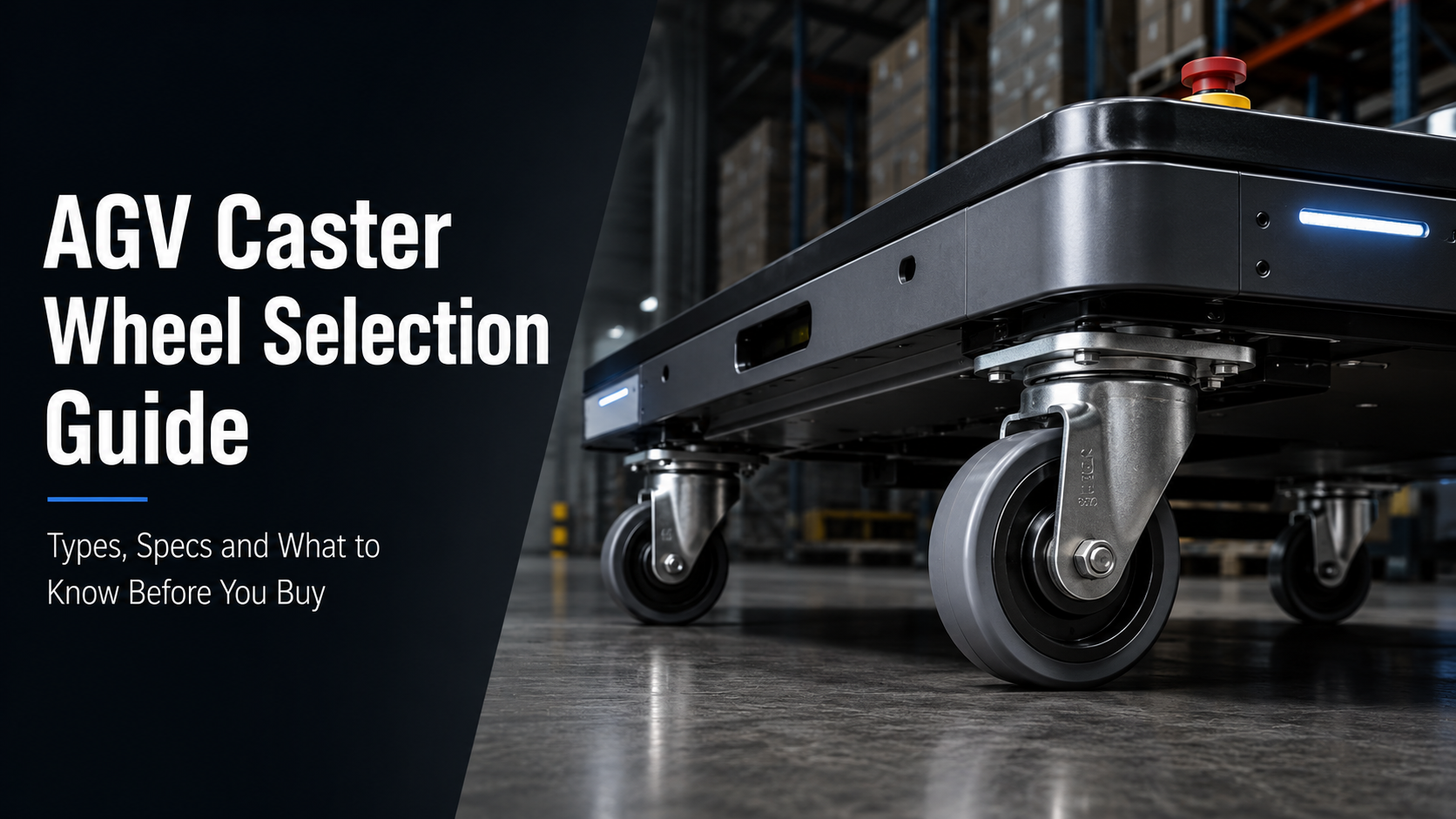
Every AGV has drive wheels that propel and steer the vehicle, and caster wheels that support the chassis and allow it to follow whatever path the drive system commands. The drive wheels get the engineering attention. The casters are often selected late in the design cycle, sized by feel, and sourced from the nearest catalogue. This pattern reliably produces problems — floor marking, excessive rolling resistance, chassis vibration, and premature bearing failure — that are traced back to caster specification only after considerable troubleshooting effort.
Caster wheel selection for AGV applications is not complicated, but it is systematic. Load capacity, wheel diameter, tread hardness, swivel geometry, and floor surface compatibility each play a defined role in how the caster performs under real operating conditions. Getting all of them right at specification time costs nothing. Getting them wrong costs time, maintenance labor, and floor damage that has to be explained to the facility operator.
This guide covers the main caster wheel types used in AGV and AMR applications, the specifications that govern selection, how casters interact with the rest of the drive system, and the sourcing criteria that distinguish reliable components from catalogue fillers.

What Is an AGV Caster Wheel and What Role Does It Play
A caster wheel is a passive support element — it carries a portion of the vehicle's weight and rolls freely to follow the direction of travel commanded by the driven wheels. Unlike drive wheels, casters do not receive motor torque or active steering commands. Their job is to support the chassis, maintain floor contact, and offer minimum resistance to the direction changes imposed by the drive system.
In most AGV and AMR configurations, the driven wheels provide traction and directional control, while two or more caster wheels provide the remaining support points that keep the chassis level and stable. The number, size, and placement of casters affect the vehicle's center of gravity, its stability under off-center loads, and the force required to initiate and sustain turns.
Because casters are passive, their contribution to system performance is easy to underestimate. But a caster that flexes, drags, or oscillates under load introduces disturbances into the vehicle's motion that the navigation system must either compensate for or accept as position error. In high-accuracy docking applications, caster behavior is a direct contributor to final positioning repeatability.
Main Types of AGV Caster Wheels
Swivel Caster
The swivel caster uses a bearing-mounted fork that rotates freely around a vertical axis, allowing the wheel to align with any direction of travel without external actuation. This is the standard caster type for AGV and AMR applications because it allows the vehicle to change direction without dragging or scrubbing the support wheels across the floor.
The swivel offset — the horizontal distance between the swivel axis and the wheel centerline — determines how quickly the caster aligns with the direction of travel when the vehicle changes heading. Larger offsets provide faster self-alignment but increase the side force generated during rapid direction changes. The swivel bearing must be sized for the combined radial and axial loads at the application wheel load, including dynamic factors for cornering.
Rigid Caster
A rigid caster has a fixed fork with no swivel capability — the wheel rolls only in one fixed direction. Rigid casters are used on AGVs where the direction of travel is constrained to a single axis, or where the drive system geometry makes swivel casters mechanically inconvenient. They are simpler and lower cost than swivel casters but cannot accommodate direction changes without scrubbing, which limits their use to straightforward point-to-point AGV applications on straight track layouts.
Dual-Wheel Caster
A dual-wheel caster mounts two wheels side by side on a shared axle under a single swivel fork. This configuration doubles the wheel contact area without increasing the caster's physical footprint, which reduces floor contact pressure under high loads and improves stability on slightly uneven surfaces. Dual-wheel casters are common on heavy-payload AGV platforms where load distribution across the floor is a design requirement, and on platforms operating on floors with load-bearing restrictions.
Shock-Absorbing Caster
Shock-absorbing casters incorporate a spring or elastomeric element between the fork and the mounting plate that allows the wheel to deflect vertically under impact loads. These are used on AGVs that traverse floor joints, dock leveler plates, or surface transitions where hard impacts would otherwise transmit shock loads into the chassis and sensitive onboard equipment. The spring rate must be matched to the application load — too soft and the caster bottoms out under static load, too stiff and it provides no isolation benefit.

Key Specifications for AGV Caster Wheel Selection
Load Capacity
Each caster's dynamic load rating must cover its share of the vehicle's maximum gross weight — chassis, battery, payload, and all onboard equipment — plus a service factor for dynamic loads during cornering and acceleration. The load distribution across casters depends on chassis geometry and the position of the vehicle's center of gravity relative to the caster mounting points.
A common error is dividing total gross weight equally across all casters without accounting for center of gravity offset. An AGV with an asymmetric battery pack or off-center payload capacity may place significantly more than the average load on specific caster positions. Each caster should be rated for its worst-case load condition independently, not for the average vehicle weight divided by caster count.
Apply a dynamic service factor of at least 1.3 to the calculated maximum load per caster. This accounts for floor surface irregularities, ramp transitions, and the impact loads generated when wheels cross floor joints or pallet runner gaps.
Wheel Diameter
Larger wheel diameters roll over floor obstacles and surface irregularities more easily, reduce rolling resistance on uneven surfaces, and distribute load across a longer contact patch. Smaller diameters are more compact and allow lower chassis ride heights, which is important for latent AMR and low-profile vehicle designs.
For most indoor warehouse AGV applications, caster wheel diameters between 50mm and 150mm cover the range from compact light-AMR designs to heavy-payload platform supports. The minimum wheel diameter for a given application is set by the largest floor obstacle the vehicle must reliably traverse — a wheel smaller than twice the height of the largest floor step or joint gap will catch rather than roll over it.
Tread Material
The wheel tread material governs traction, floor marking tendency, noise level, rolling resistance, and wear rate. Selecting the wrong tread material for the floor surface is one of the most common and most consequential caster specification errors.
Polyurethane is the standard choice for smooth concrete floors in indoor logistics environments. It offers low rolling resistance, minimal floor marking, moderate shock absorption, and good wear resistance at the load levels typical of warehouse AGVs. Shore hardness selection — typically 80A to 95A — involves a trade-off between load distribution and wear life: softer compounds spread load over a wider contact patch and reduce peak floor pressure but wear faster under heavy loads and high cycle rates.
Rubber treads provide better shock absorption and floor surface conformity than polyurethane, making them suitable for rougher surfaces or applications with significant floor joint transitions. They mark some floor coatings under load and have higher rolling resistance than polyurethane on smooth surfaces. Nylon and hard plastic wheels are used in clean-room and food logistics environments where hygiene requirements preclude rubber or polyurethane compounds, at the cost of higher floor contact pressure and reduced shock absorption.
Swivel Radius and Chassis Clearance
The swivel radius — the distance from the mounting plate centerline to the outermost point of the swivel fork in rotation — determines how much chassis floor space the caster occupies during direction changes. On compact AGV platforms where chassis real estate is limited, swivel radius is a packaging constraint that may govern caster selection as much as load or tread specifications.
Fork height — the distance from the mounting plate to the floor surface — determines the chassis ride height contribution from the caster. Consistent fork heights across all caster positions are necessary to keep the chassis level. Mixing casters of different fork heights introduces chassis tilt that affects sensor alignment, lifting mechanism geometry, and shelf engagement accuracy.
Bearing Type and Sealing
Caster wheel bearings carry both the vertical load and the lateral forces generated during cornering. For AGV applications with continuous operation, precision ball bearings with adequate load ratings and appropriate sealing are necessary. Open bearings without sealing will accumulate floor debris and lubricant contaminants that accelerate wear in warehouse environments. Sealed or shielded bearings extend service intervals significantly and are strongly preferred for production AGV deployments.
The swivel bearing — which carries the combined radial load of the wheel assembly plus the lateral torque generated during cornering — is often the first bearing to fail in undersized or poorly sealed casters. Verify swivel bearing ratings against the actual load case at the wheel position, not just the wheel bearing ratings.
How Caster Wheels Interact with the AGV Drive System
Casters do not operate independently of the drive system — their behavior during cornering, acceleration, and stopping directly affects drive wheel traction and vehicle path tracking accuracy.
During a turn, the drive wheels generate a yaw moment that the casters must follow by swiveling to align with the new direction of travel. The lag between commanded heading change and actual caster alignment creates a transient side force on the chassis that the drive wheels must overcome. This force increases with vehicle speed, corner radius tightness, and caster swivel offset. On high-speed AGVs with tight path requirements, caster dynamics can be a measurable contributor to path tracking error during turning maneuvers.
Caster rolling resistance also affects drive wheel torque demand. A caster with contaminated or undersized bearings, or a tread compound poorly matched to the floor surface, increases the total tractive resistance the drive motors must overcome. On battery-powered AGVs where energy efficiency is a design parameter, caster rolling resistance contributes to energy consumption in every operating cycle.
Chassis stability under payload — particularly under asymmetric or dynamically shifting loads — depends on caster placement geometry. The caster positions relative to the drive wheels and the payload center of gravity determine the vehicle's resistance to tipping under worst-case load distribution. For AGVs handling variable or unknown payload geometries, caster placement should be analyzed against the full range of possible load conditions, not just the nominal centered load case.

Common Caster Selection Mistakes on AGV Programs
Sizing to average load rather than worst-case per-caster load. Total vehicle weight divided equally across all casters rarely reflects the actual load on any individual caster. Center of gravity position, chassis geometry, and payload distribution create unequal loading that must be analyzed per caster position. A rear caster on an AGV with a front-heavy battery pack may carry twice the load of a front caster under the same gross vehicle weight.
Selecting tread material from catalogue defaults without floor analysis. Polyurethane is appropriate for the majority of indoor warehouse floor surfaces, but assuming it is appropriate for every application leads to floor marking problems in facilities with sensitive coatings, excessive wear in environments with abrasive debris, or hygiene compliance failures in food and pharmaceutical logistics. Tread material selection should be confirmed against actual floor surface and environmental conditions.
Ignoring swivel bearing load ratings in favour of wheel bearing ratings only. Catalogue load ratings for casters are sometimes presented for the wheel bearing only, not the swivel bearing assembly. In cornering applications, the swivel bearing experiences the highest loads and is often the first to fail. Confirm that published load ratings include swivel bearing capacity under the dynamic lateral forces of the intended application.
Mixing caster sizes across a vehicle to use up existing stock. Different fork heights or wheel diameters across caster positions introduce chassis tilt, unequal load distribution, and irregular floor contact that compounds over time as different casters wear at different rates. Consistent caster specification across all positions on a vehicle is a basic design hygiene requirement.
What to Look for in an AGV Caster Wheel Supplier
AGV-rated product range with documented load testing. General-purpose industrial casters are rated for static or slow-movement material handling applications. AGV casters must perform reliably under the higher cycle counts, dynamic loads, and continuous operation typical of warehouse automation. Suppliers should be able to provide load and fatigue test data relevant to AGV duty cycles, not just static load ratings from standard caster catalogues.
Material and hardness options matched to floor types. A supplier offering only one tread compound for all applications is not providing engineering guidance — they are providing a parts list. Credible AGV caster suppliers offer polyurethane in multiple hardness grades, alternative tread materials for specific environments, and guidance on matching tread specification to floor surface and load conditions.
Consistent dimensional standards for fleet production. Fork height, mounting bolt pattern, and wheel diameter must be consistent across production batches to ensure that casters installed as replacements match the geometry of the units they replace. Suppliers that cannot guarantee dimensional consistency across production runs create maintenance complications in deployed AGV fleets.
Availability of sealed bearing variants. Open bearing casters suitable for light, intermittent-use material handling equipment are not adequate for continuous AGV operation in dusty warehouse environments. Sealed bearing variants should be standard availability, not a special order item, from any supplier being considered for AGV production programs.
FAQ
How many caster wheels does a typical AGV need?
Most AGV and AMR platforms use two or four caster wheels to provide the required support points alongside one or two driven wheels. Two-caster configurations are common on compact latent AMRs with a central drive wheel. Four-caster configurations are standard on larger platforms where stability under variable payload distribution is required. The number and placement of casters should be determined by chassis stability analysis across the full range of load conditions, not by convention.
What caster wheel diameter is recommended for standard warehouse floors?
For smooth concrete floors in standard indoor warehouse environments, caster wheel diameters between 75mm and 125mm are typical for light to medium-payload AGVs. Larger diameters — 100mm to 150mm — are preferred for heavier platforms or floors with more significant surface irregularities. The minimum diameter should be at least twice the height of the largest floor obstacle the vehicle must traverse reliably.
Can polyurethane caster wheels mark the floor?
Standard polyurethane compounds have low floor marking tendency on bare concrete and most industrial floor coatings. However, softer polyurethane compounds under heavy loads, or polyurethane wheels on waxed or polished floor surfaces, can leave visible marks during cornering maneuvers where side forces are highest. Non-marking polyurethane compounds are available for facilities with sensitive floor coatings and should be specified when floor marking is a documented facility requirement.
What is the difference between a caster load rating and a drive wheel load rating?
Both are dynamic load capacity ratings, but the loading conditions differ. Drive wheel load ratings must account for traction forces in addition to vertical load — the wheel simultaneously carries chassis weight and transmits horizontal traction force to the floor. Caster load ratings cover vertical load and the lateral forces generated during cornering, but not traction forces. This means a caster and a drive wheel with the same load rating are not equivalent — the drive wheel specification must additionally cover traction load cases that do not apply to passive casters.
How often should AGV caster wheels be replaced?
Service life depends on load level, operating cycle rate, floor surface condition, and tread material. In typical continuous warehouse AGV operation, polyurethane caster wheels on smooth concrete commonly achieve 6,000 to 12,000 hours before tread wear reaches replacement threshold. Bearing service life is typically longer than tread life under clean operating conditions. A preventive maintenance schedule based on tread wear measurement and bearing noise inspection — rather than fixed time intervals — is the most cost-effective approach for production AGV fleets.
Conclusion
AGV caster wheel selection is not the most technically demanding component decision in drivetrain design, but it is one of the most consequential when done poorly. Load capacity analysis per caster position, tread material matching to floor surface, bearing sealing for continuous operation, and dimensional consistency across production batches are all straightforward requirements that prevent the fleet-wide maintenance problems that follow from treating caster selection as an afterthought.
For engineering teams specifying casters for new AGV platforms, the investment in proper load analysis and material selection at design stage consistently returns more value than the equivalent time spent troubleshooting floor marking, bearing failures, or chassis stability issues after deployment.
Share:
Forklift AGV Drive Wheel: How to Choose the Right Unit for Heavy Payload Applications
AGV Steering Wheel Selection Guide: Load, Speed, Motor Power, And Installation Space